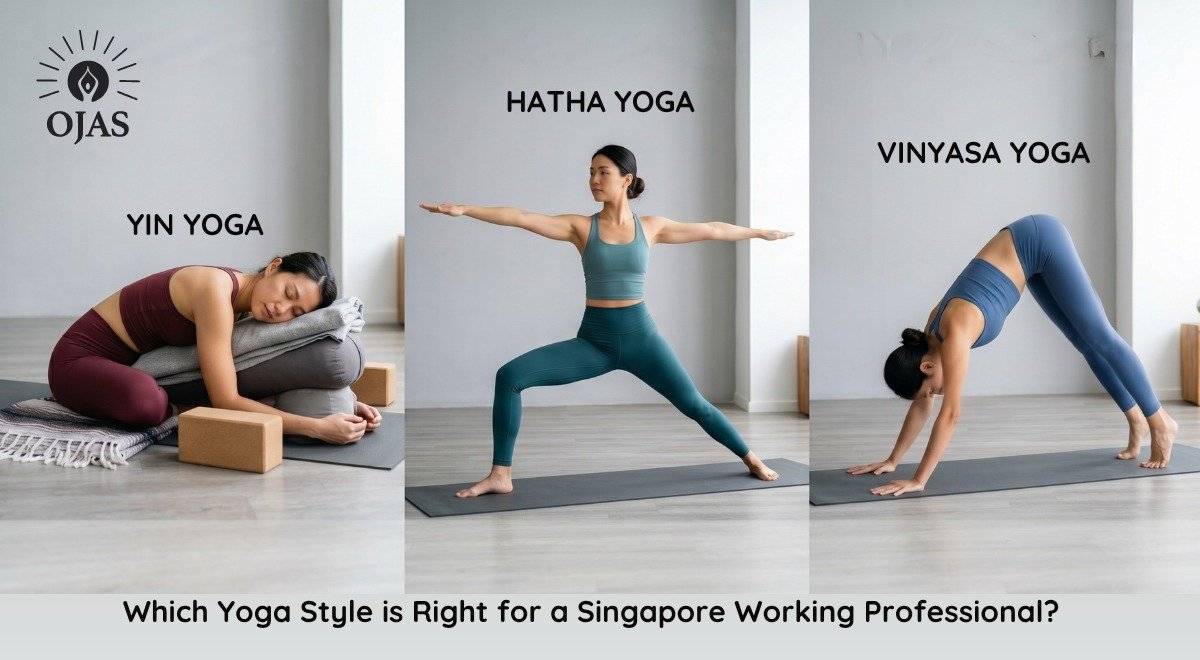
Most studio timetables list class names without translating them into physical outcomes. “Hatha 60” and “Vinyasa Flow” sit side by side on a booking screen with nothing to indicate whether one will leave you able to go back to a boardroom or flat on the floor. For the Singapore professional approaching yoga with limited time, a specific physical complaint, and no interest in guessing, that ambiguity is the first obstacle between intention and attendance.
The three styles that dominate Singapore’s CBD studio landscape — Yin Yoga, Hatha Yoga, and Vinyasa Flow — operate on fundamentally different anatomical targets, different pacing structures, and different relationships with the stressed, desk-bound body they are most likely to receive. Understanding what distinguishes them is not a prerequisite for spiritual practice. It is a practical decision-making tool that determines which class you book, when you book it, and whether it addresses the physical reality you walk in with.
What Are the Core Differences Between Yin, Hatha, and Vinyasa Yoga?
The three styles differ across five parameters that matter specifically to the working professional: pace, anatomical target, breath mechanics, heat generation, and post-class recovery requirement. Each parameter has direct implications for how the style fits into a corporate schedule and what it does to the body that has been sitting at a desk since 8am.
| Parameter | Yin Yoga | Hatha Yoga | Vinyasa Flow |
|---|---|---|---|
| Pace | Very slow — 3–5 min per pose | Moderate — 5–10 breaths per pose | Fast — 1 breath per movement |
| Primary Anatomical Target | Fascia, connective tissue, ligaments, joint capsules | Skeletal muscle, postural alignment, balance | Cardiovascular system, skeletal muscle, muscular endurance |
| Breath Mechanics | Natural, passive — breath used to deepen into stillness | Deliberate — breath coordinates with static holds | Ujjayi breath links every movement in continuous flow |
| Heat Generation | Minimal — floor-based, no dynamic movement | Low to moderate — progressive but controlled | High — sustained movement raises core temperature significantly |
| Post-Class Recovery | Minimal — suitable for direct return to professional environment | Light shower adequate for most sessions | Full shower required; 20–30 min recovery before cognitive work |
| Best Time Slot | Lunchtime or after-work | Morning, lunchtime, or after-work | Before-work or after-work (not lunchtime) |
| Ojas Yoga Equivalent | Yin group class | Hatha group class, Alignment Workshop | Vinyasa group class, Weight Loss Yoga |
How Does Yin Yoga Target Deep Connective Tissue?
The physiological mechanism of Yin Yoga is distinct from every other yoga style and frequently misunderstood. Yin is not slow Vinyasa. It is not restorative yoga, though it shares some surface similarities. It is a practice specifically designed to apply sustained, static mechanical stress to fascia — the web of connective tissue that surrounds and interpenetrates every muscle, bone, organ, and nerve in the body.
Research published in the Journal of Bodywork and Movement Therapies (2014) on fascial plasticity established that sustained, static stretch — the kind that holds a posture for three to five minutes at low muscle activation — alters the viscoelastic properties of fascia through a process called plastic deformation. Dynamic movement, by contrast, targets the muscle belly but largely bypasses the fascial network. A Vinyasa class that moves through 40 postures in 60 minutes does not produce the same tissue change as a Yin class that holds five postures for the same duration. They are physiologically distinct interventions.
For the Singapore professional who has been sitting in anterior pelvic tilt for eight to ten hours a day, the connective tissue along the hip flexor line — the iliopsoas, the hip capsule ligaments, the thoracolumbar fascia — has been held in a shortened, compressed state for far longer than any dynamic stretching session can undo. Yin is the appropriate tool for this specific adaptation, not because it is gentle (held postures are frequently more demanding than dynamic ones) but because it is targeted at the correct tissue layer.
Why Is Hatha Yoga Considered the Structural Foundation of Modern Practice?
Hatha Yoga is the system from which most modern yoga styles — including Vinyasa, Iyengar, and Ashtanga — originate. In its contemporary studio form, a Hatha class focuses on individual asana (posture) held with alignment precision and coordinated breath, typically progressing from standing to seated to floor-based sequences. The pace is moderate: enough time in each posture to establish correct structural position, not enough to allow passive tissue creep into the connective tissue target that Yin requires.
The defining characteristic that makes Hatha the most appropriate starting point for practitioners new to yoga is its technical emphasis. A well-taught Hatha class provides the anatomical vocabulary — how weight distributes through the foot in Tadasana, how the scapulae position in a backbend, what the pelvis does in a standing forward fold — that makes every subsequent class safer and more effective. Practitioners who move directly to Vinyasa without Hatha foundation frequently reinforce poor movement patterns at speed, producing the compensatory injuries that show up three to six months into a regular practice.
For the CBD professional specifically, Hatha directly addresses the postural adaptations of desk work: anterior head carriage from screen use, rounded thoracic spine from sustained keyboard posture, the weakened posterior chain that produces lower back loading. These are not cosmetic concerns. They are the structural patterns that determine whether a professional at 45 has the physical capacity their career will still demand at 55. The Yoga Alignment Workshop at Ojas extends this further — a dedicated technical session that builds the structural understanding to practise any style more safely.
What Makes Vinyasa the Most Cardiovascular of the Three Styles?
Vinyasa Flow, sometimes called flow yoga, is characterised by the continuous linking of breath to movement: each inhale initiates one action, each exhale completes another. The sequence progresses without static holds, creating a moving meditation that raises heart rate, generates significant internal heat, and builds both muscular strength and cardiovascular endurance within a single session. The pace is the variable that most clearly separates Vinyasa from the other two styles — a practitioner in a well-taught Vinyasa class moves continuously for 45–60 minutes, never resting in a posture for more than two to three breaths.
The heat generation of Vinyasa in Singapore’s studio context carries a practical implication that most style guides don’t address: the equatorial climate means that the temperature differential between a heated Vinyasa studio and the CBD outdoor environment is relatively small. A practitioner who exits a Vinyasa class and walks five minutes to Raffles Place MRT in 32°C ambient humidity generates additional perspiration on top of the post-class sweat load. The post-class shower at Ojas Yoga — both the quick-dry in-studio option and the full shower outside — is the infrastructure that makes Vinyasa compatible with a professional schedule. Without it, the style is effectively limited to before-work sessions where the return transit is to a home environment rather than an office one.
How Do These Yoga Styles Alleviate Common Corporate Health Issues in Singapore?
Singapore’s Ministry of Manpower data and the National Workplace Health Survey consistently place occupational burnout among the leading workforce health concerns in the Republic. The 2023 survey found that over 60% of Singapore employees reported feeling burnt out at work, with professionals in the financial, legal, and technology sectors reporting the highest incidence. The physiological correlates of burnout — chronically elevated cortisol, suppressed immune function, disrupted sleep architecture, and the musculoskeletal consequences of sustained sedentary posture — are not resolved by generic wellness programmes. They require interventions that address their specific biological mechanisms.
The science of how yoga reduces cortisol has been established across multiple clinical studies: regular practice produces a 23–27% reduction in salivary cortisol within eight weeks, with measurable changes in parasympathetic nervous system tone. The question for the Singapore professional is not whether yoga helps — the research establishes that it does — but which style produces which specific benefit for their particular presentation of corporate health dysfunction.
Which Yoga Style Best Addresses Tech Neck and Desk Posture?
Tech neck — the clinical term is cervicogenic headache complex combined with upper crossed syndrome — is the pattern of anterior head carriage, protracted scapulae, weakened deep cervical flexors, and tight suboccipital muscles that develops from sustained screen use. The Singapore professional who spends eight hours with a laptop positioned slightly below eye level and a chin that progressively translates forward is building a structural compensation that, over years, produces chronic cervicogenic pain, intermittent headaches, and the shoulder impingement that follows rotator cuff shortening.
Hatha Yoga addresses this most directly. The postural correction work in a well-taught Hatha class — chin tucks, thoracic extension sequences, shoulder-opening postures, the deliberate repositioning of the scapulae against the posterior rib cage — reverses the upper crossed pattern systematically. The pace of Hatha allows this to be taught with anatomical precision rather than moved through as part of a flow sequence. Ojas Yoga’s approach to this through structured therapeutic practice is covered in depth in the tech neck and back pain guide — a useful companion to understanding what you’re actually correcting in a Hatha class.
Yin Yoga contributes to tech neck resolution through a different mechanism: the cervical and thoracic Yin postures — supported fish, thread-the-needle, melting heart — provide sustained passive opening of the anterior chest and posterior neck that complements the active correction work of Hatha. The two styles together address the full tissue complex: Hatha retrains the muscular pattern, Yin releases the fascial restrictions that have accumulated around it.
Which Style Is Most Effective for Lowering Cortisol After a Demanding Workday?
The research answer and the practical answer are the same: Yin Yoga in the evening produces the most direct cortisol-lowering effect of the three styles. Research in the Journal of Alternative and Complementary Medicine (2017) confirmed that yoga practice significantly decreases salivary cortisol and modulates the sympathetic nervous system — and the specific mechanism of Yin (sustained stillness, passive floor-based postures, long-duration breath focus) is more directly parasympathetic-activating than either Hatha or Vinyasa.
The evening context amplifies this. A professional who attends a Yin class at 6:30pm, holds hip-opening and spinal-decompression postures for three to five minutes each, and practises nadi shodhana (pranayama — alternate nostril breathing) in savasana exits the studio with a measurably different cortisol profile than the one they entered with. The research consensus, as covered in the corporate yoga benefits research, supports this as both a performance and wellbeing intervention — not a wellness gesture.
For professionals whose cortisol dysregulation has progressed beyond what a single weekly Yin class can address, the MBSR 8-Week Mindfulness-Based Stress Reduction programme at Ojas operates at the structural level — producing changes in the hypothalamic-pituitary-adrenal axis that a group class format cannot replicate. Eight weeks of evidence-based, clinically grounded mindfulness practice produces documented HPA axis recalibration that outlasts the programme itself.
Which Style Supports Weight Management Goals for Desk-Bound Professionals?
Vinyasa is the correct answer for the professional whose primary goal is caloric expenditure and metabolic activation alongside the stress management benefits of yoga. A 60-minute Vinyasa class at Ojas burns approximately 300–450 kcal for an average adult — comparable to moderate-intensity cycling or a brisk run — while also delivering the breath regulation and mindfulness components that pure cardio exercise does not. The Weight Loss Yoga programme at Ojas specifically sequences the practice for this outcome, combining dynamic flow with targeted strengthening and pranayama for metabolic support.
The Yin Yoga contribution to weight management is indirect but real: the chronic cortisol elevation associated with occupational burnout is strongly associated with visceral fat accumulation, particularly in the abdominal region. A practice that systematically reduces cortisol — which Yin does — reduces the hormonal driver of stress-related weight gain. Professionals who combine Vinyasa for active expenditure with Yin for cortisol regulation are addressing the metabolic problem from both directions. The complete yoga for weight loss guide maps this relationship in detail, including which asanas produce the most measurable results and at what practice frequency.
Does Vinyasa or Hatha Yoga Provide Better Outcomes for Lower Back Pain?
This is one of the most frequently searched questions in the Singapore yoga market and the one where the generic online answer is most likely to mislead. The correct answer depends entirely on the origin of the lower back pain.
Lower back pain that originates from muscle weakness and postural imbalance — the most common pattern in desk-bound professionals, driven by a weak posterior chain, tight hip flexors, and anteriorly tilted pelvis — responds best to Hatha Yoga. The deliberate alignment work, the emphasis on posterior chain engagement (Warrior sequences, Bridge, Locust), and the controlled pace that allows real proprioceptive learning make Hatha the most appropriate structural intervention.
Lower back pain that originates from fascial restriction and disc compression — pain that worsens with sitting, improves with gentle movement, and produces the “tightness” sensation of the lower lumbar region — responds better to Yin. Poses like Sleeping Swan, Sphinx, and Shoelace provide sustained decompression of the lumbar spine and iliotibial complex that dynamic yoga does not reach. The Yoga Therapy for Back Pain guide explains the distinction in clinical terms that are useful for anyone trying to understand why one approach is working and another isn’t.
For persistent lower back conditions that don’t resolve with group class practice, Yoga Therapy at Ojas provides individual assessment and sequencing that a group format structurally cannot. The SpineCare 4-Week Structural Reset offers the middle ground — a structured programme specifically addressing spinal health patterns accumulated from years of desk work, more targeted than a general class, more accessible than individual therapy.
How Can a Singapore Professional Fit Yoga Into a Busy Corporate Schedule?
The scheduling question is where the style comparison becomes a personal logistics problem. The biological case for each style has been made. The question now is: given a typical CBD professional’s actual week — with its 8am starts, unpredictable lunch windows, and 7pm exits — which style is realistically sustainable, and when?
The answer requires mapping each style against three variables that the Singapore CBD context makes non-negotiable: time management within the lunch window, shower and transit logistics, and the relationship between class intensity and the cognitive demands of the work that follows. The detailed timing analysis — including the circadian science of when each style is most physiologically appropriate — is covered in the before-work vs lunchtime vs after-work yoga guide. What follows here is the style-specific summary.
When Is Yin Yoga Most Practical for a CBD Professional?
Yin is the most logistically versatile style for the CBD professional precisely because it generates the least post-class recovery requirement. A 45-minute Yin class at lunchtime — no significant perspiration, no elevated heart rate to recover from, no post-class fatigue that competes with afternoon cognitive work — is compatible with a return to a client-facing role within 15 minutes of class end. At Ojas Yoga, the changing room, lockers, and pantry support this transition without requiring the full shower infrastructure that a Vinyasa session demands.
After-work Yin — the 6:30pm or 7pm slot — is the most physiologically aligned timing, as discussed in the CBD yoga guide. Peak muscle elasticity at that hour makes the deep connective tissue work more accessible, and the parasympathetic activation that Yin produces is directly aligned with the pre-sleep nervous system preparation that most CBD professionals need and consistently fail to provide themselves.
When Does Hatha Fit Best Into a Corporate Week?
Hatha is the most schedule-neutral of the three styles because its moderate intensity and controlled pace make it compatible with morning, lunchtime, and evening slots without major logistical compromise. A morning Hatha class at 7am sets the postural and neurological tone for the working day; a lunchtime Hatha class provides the cortisol interruption and cognitive reset without the post-class recovery demand of Vinyasa; an evening Hatha class closes the day with structural work and breath regulation that neither overwhelms the nervous system nor leaves the practitioner too energised to sleep.
For the professional new to yoga who is uncertain about their physical capacity and wants a style they can enter without injury risk, Hatha is the correct starting point. The Ojas group class timetable shows available Hatha sessions across all three time windows, with the starting yoga in your 30s and 40s guide providing the contextual foundation for professionals who are returning to physical practice after a prolonged gap.
How Do You Introduce Vinyasa Without Disrupting Your Professional Schedule?
Vinyasa is the style that requires the most deliberate scheduling to be sustainable in the CBD context. The before-work slot is the most structurally protected: a 7am Vinyasa class ending at 8am, followed by a full shower at Ojas and a composed MRT journey during the pre-rush window, delivers the practitioner to the office by 9am in a neurochemical state — elevated endorphins, post-exercise dopamine, the metabolic activation of a genuine cardiovascular session — that improves performance for the first several hours of the working day.
The after-work slot is the second viable option, with the caveat established in the timing research: Vinyasa ending after 8pm creates a physiological recovery window that is insufficient for quality sleep by 11pm. If after-work Vinyasa is your chosen format, the 6pm class ending at 7pm leaves a four-hour recovery window that is compatible with sleep. The 7:30pm class is the boundary — anything later, and the practice that was meant to relieve stress begins to compound it through sleep disruption.
For the professional who wants to build a complete practice — Vinyasa for cardiovascular and metabolic engagement, Hatha for structural alignment, Yin for nervous system regulation and deep tissue release — the private yoga session at Ojas is the most efficient way to establish a personalised programme across all three styles before committing to a regular group class structure. One session with an experienced instructor who can assess your physical presentation and schedule constraints produces a practice framework that generic group class attendance rarely achieves in the first three months.
Which Yoga Style Should You Choose First?
The decision matrix is simpler than the volume of information above might suggest. Answer two questions: what is your primary physical complaint right now, and what time slot can you actually protect in your working week?
If your primary complaint is lower back tension, tight hips, or the generalised stiffness of someone who sits for a living — and you have a lunchtime or evening slot available — begin with Yin. The physical relief is the most immediate of the three styles for that specific presentation, and the low post-class recovery demand makes it the most sustainable in a constrained schedule.
If your primary complaint is postural deterioration, tech neck, or the sense that your body has forgotten how to move correctly — and you’re new to yoga — begin with Hatha. The technical foundation it provides improves every subsequent class you take, regardless of style. The distinction between general yoga and yoga therapy is worth understanding at this stage — Hatha group classes address the pattern, Yoga Therapy addresses the individual.
If your primary goal is metabolic activation, cardiovascular fitness, or weight management — and you have a reliable before-work slot — begin with Vinyasa, ideally after a few Hatha sessions that establish your movement vocabulary. The yoga vs gym comparison is a useful reference for professionals who are deciding how to position yoga relative to an existing fitness routine rather than replacing one entirely.
In practice, the most resilient CBD yoga practice is not built on one style. It is built on a primary style that anchors the week — the one that fits your most protected time slot and addresses your most pressing physical need — supplemented by a secondary style that covers what the first one doesn’t. Yin and Vinyasa together cover the full spectrum from connective tissue release to cardiovascular engagement. Hatha and Yin together provide the structural correction and nervous system regulation that most desk workers need most. The CBD studio guide covers the broader studio landscape, and the booking guide covers the logistics of securing your preferred slots before they fill.
The starting point at Ojas Yoga is the group class schedule. The 3-class trial at $49 SGD covers any combination of Yin, Hatha, and Vinyasa sessions — enough to experience each style once and make an informed decision about which becomes your primary practice.