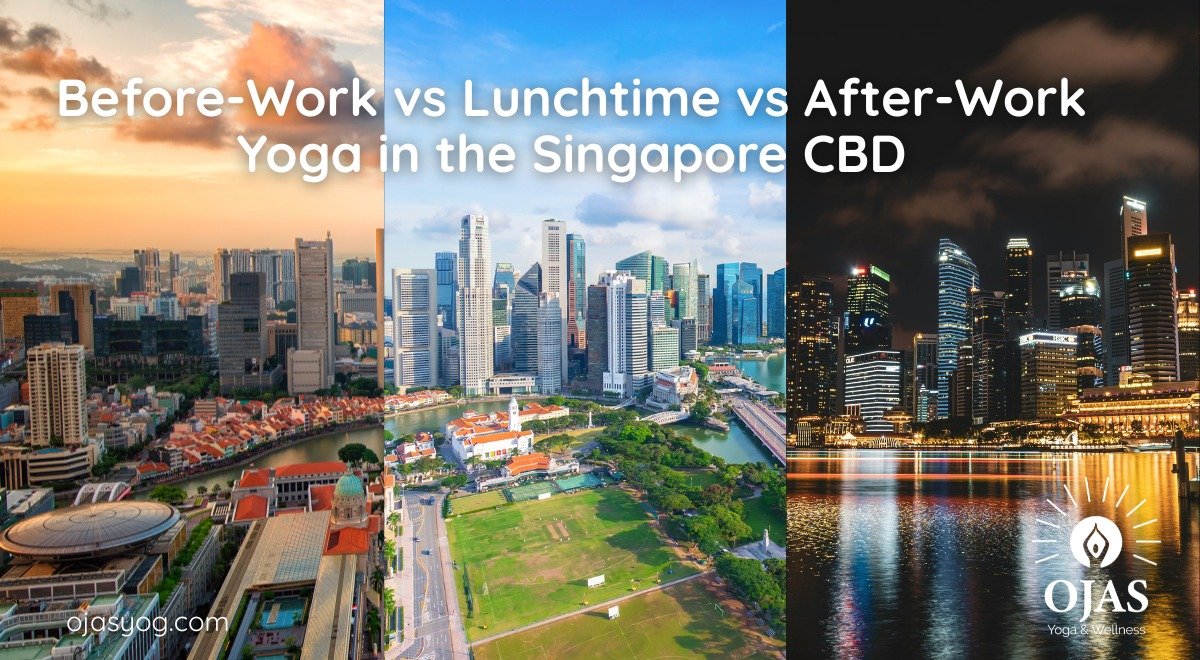
Most fitness guides answer this question in the abstract: morning yoga energises, evening yoga relaxes. That framing is accurate for someone practising in a quiet suburb with a flexible schedule. It is not accurate for a senior associate at a Raffles Place law firm who needs to be at a standing desk by 8:30am, whose lunch breaks run 50 minutes on a good day, and whose 7pm meeting may or may not have been cancelled. The Singapore Central Business District imposes logistical constraints that generic wellness advice does not account for — and those constraints determine which yoga timing is actually sustainable, not just theoretically optimal.
This is not a guide to the best time to do yoga. It is a guide to the best time to do yoga when you work in the CBD, with specific reference to commute windows, shower infrastructure, digestive timing, cortisol rhythms, and what the science of circadian rhythm says about injury risk at different points in the day. The answer is different for every professional. The framework for reaching it is the same.
What Are the Key Differences Between Morning, Lunchtime, and Evening Yoga in the CBD?
Each time slot carries a distinct biological profile, a distinct logistical reality, and a distinct relationship with the working day that surrounds it. Understanding all three before choosing one is how a yoga practice becomes a sustainable weekly structure rather than an experiment that doesn’t survive the first month.
| Time Slot | Biological State | Primary Benefit | Ideal Style at Ojas | Key Logistical Factor |
|---|---|---|---|---|
| Before-Work (6:30–8:00am) | Cortisol Awakening Response — cortisol naturally peaking | Mental clarity, metabolic activation, day-setting | Vinyasa Flow, Hatha, Sun Salutation sequences | Lower muscle temperature — warm-up essential; MRT uncrowded |
| Lunchtime (12:00–1:30pm) | Cortisol declining; insulin post-meal if eaten; mid-day brain fog window | Cognitive reset, afternoon performance, stress interruption | Mid-Day Reset Breathwork, Hatha, Yin | 45–50 min class window; post-class shower and return-to-desk transit |
| After-Work (6:00–8:30pm) | Core body temperature peak; muscle elasticity 15–20% higher than morning | Deep decompression, nervous system down-regulation, identity transition | Yin Yoga, Sound Bowl, Restorative, gentle Hatha | Peak MRT congestion (17:30–19:30); late intensive classes risk sleep disruption |
How Does Your Circadian Rhythm Dictate Your Ideal Yoga Timing?
The circadian rhythm is the 24-hour biological clock that regulates cortisol production, core body temperature, muscle elasticity, alertness, and sleep onset. Research published in Psychoneuroendocrinology (2015) confirms that the Cortisol Awakening Response — the natural 50–100% spike in cortisol within the first 30–45 minutes of waking — provides a physiological platform for morning exercise that the body is literally primed for. Capitalising on this window with a dynamic practice builds on what the body is already doing, rather than working against it.
By contrast, research in the Journal of Sports Sciences (2012) documents that core body temperature peaks in the late afternoon and early evening, producing a 15–20% increase in muscular flexibility compared to early morning. This means that the deepest connective tissue work — Yin holds, full spinal forward folds, hip-opening sequences — is physiologically most accessible in the evening, not the morning. Attempting the same depth of passive stretching at 7am that is available at 7pm requires a significantly longer warm-up and carries a measurably higher soft tissue injury risk.
Your chronotype — whether you are constitutionally an early riser or an evening-oriented person — modifies both of these windows. A practitioner whose alertness and physical readiness peak at 6:30am will extract more from a morning Vinyasa class than a practitioner who requires until 9am to feel physiologically functional. Neither chronotype is correct. Both should inform the timing decision.
Why Choose Before-Work Yoga in the Singapore CBD?
The 6:30am to 8:00am window carries advantages that no other time slot in the CBD offers. The MRT is operating at 30–40% of peak capacity during this window — the morning rush concentrates between 8:00 and 9:30am. A practitioner who completes a 7am class and showers by 7:50am travels to their office on an uncrowded platform, arrives at their desk before the day’s first email flood, and has already generated a neurochemical environment — elevated endorphins, declining cortisol relative to the post-exercise trough, heightened dopaminergic activity — that improves sustained attention and decision quality for the first three hours of the working day.
There is also a structural benefit specific to the CBD professional’s reality: the before-work slot is the only one that cannot be cancelled by a late meeting, an unexpected client call, or an escalating afternoon emergency. The lunchtime class that was confirmed at 10am is frequently sacrificed by 12:30pm. The 6:30pm class survives until 5:45pm. The 7am class exists in a window that work has not yet reached.
Which Yoga Styles Work Best Before Work and Why?
Vinyasa Flow is the most physiologically aligned choice for the before-work window. The continuous breath-linked movement generates internal heat progressively — compensating for the lower core body temperature of early morning — while the cardiovascular engagement produces the endorphin and catecholamine response that elevates alertness for the working day. Ashtanga Vinyasa, which follows a fixed primary series of standing and seated postures, is particularly effective for morning practice because the known sequence allows the practitioner to enter a focused, almost meditative flow state without decision-making overhead — a useful cognitive state to carry into a demanding professional morning.
Sun Salutation sequences (Surya Namaskar) function as a complete morning activator: they progress from standing to floor to inversion to standing across each cycle, mobilising the entire spinal column, activating the posterior chain, and raising core temperature systematically. Twelve cycles in 15 minutes produces a genuine physical and neurological preparation for a high-cognitive-demand day.
The one before-work caution: passive deep stretching at low core temperature carries elevated injury risk. The same Yin posture that is appropriate at 7pm — held passively for four minutes with the connective tissue at its most pliable — should not be held at the same depth and duration at 6:45am. At Ojas Yoga, morning classes are sequenced with this in mind: the warm-up protocol for early sessions is longer, and postures that require full hamstring or hip flexor length are approached progressively rather than directly.
The before-work case for corporate professionals who need the science behind it in one place: the physiological mechanism by which yoga reduces cortisol — a 23–27% reduction within eight weeks of consistent practice — is most powerfully established when the practice is consistent. Morning practice, because it is structurally protected from work intrusion, produces more consistent attendance than lunchtime or evening practice for most CBD professionals. Consistency is the variable that determines whether yoga produces measurable physiological change or remains a periodic wellness gesture.
What Are the Logistical Realities of Before-Work CBD Yoga?
The shower question is acute for morning practitioners. A 7am class ending at 7:50am requires a studio with fast, functional shower infrastructure if the practitioner is to arrive at a client-facing role by 9am. Ojas Yoga provides both a quick-dry shower inside the studio — for practitioners on the tightest return window — and a full shower outside, with a changing room, lockers sized for work bags, and pantry access. The total transition from class end to office-ready typically runs 20–25 minutes at Ojas, which keeps the 7am–9am window viable without compression.
Booking: before-work slots at CBD yoga studios fill 24–48 hours in advance, particularly the 7am and 7:30am classes on Tuesdays and Thursdays — the peak mid-week professional wellness slots. The Ojas Yoga schedule shows live availability. Booking via the website the evening before is the minimum lead time required for reliable access to morning slots.
How Can Lunchtime Express Yoga Transform Your Workday?
The lunchtime window — 12:00 to 1:30pm — is where the cognitive reset argument for yoga is most directly testable. By midday, the average CBD professional has been in sustained sympathetic nervous system activation for three to four hours: decisions, emails, meetings, the background hum of deadline awareness. The sympathetic nervous system — the body’s operational stress state — does not switch off between tasks. It accumulates. By noon, the cortisol pattern that began well-managed in the morning has typically been extended by work stress into what researchers call allostatic overload: the body carrying more stress load than its recovery mechanisms can clear in real time.
A 45-minute yoga session interrupts that accumulation. It does not eliminate it, but it resets the baseline — returning cortisol and heart rate variability to more functional levels before the afternoon begins. The result is an afternoon that performs qualitatively better than one where lunch was spent at the desk continuing the same cognitive pattern without interruption. Singapore’s corporate wellness research consistently documents this effect: organisations that facilitate midday movement report measurable improvements in post-lunch productivity and a reduction in the 2–3pm performance trough that sedentary lunch breaks typically produce.
What Are the Digestive and Timing Constraints of Lunchtime Yoga?
Digestion is the most practically consequential constraint for lunchtime yoga, and it is the one most lifestyle guides address vaguely. The specific issue is this: inversions — shoulder stand, forward folds with the torso compressed against the thighs, downward dog held for extended periods — are contraindicated on a full stomach because they redirect digestive blood flow and can trigger nausea during practice. The practical guidance for lunchtime yoga is:
- If eating before class: allow at least 90 minutes after a full meal, 45 minutes after a light snack. A banana or small handful of nuts 30 minutes before a lunchtime Hatha or breathwork class is manageable. A chicken rice from the Lau Pa Sat hawker centre is not.
- If eating after class: this is physiologically the better arrangement for most lunchtime practitioners. A light, protein-focused post-class meal returns blood glucose to functional levels within 30 minutes and does not compete with the digestive demands of a class.
- Hydration: the equatorial climate and air-conditioned studio differential mean that hydration before a lunchtime class matters more in Singapore than in most practice contexts. 500ml of water in the 90 minutes before class is the minimum functional benchmark.
The class format matters enormously for the lunchtime window. The Mid-Day Reset: Breathwork and Sound Bath at Ojas Yoga was designed precisely for this constraint — it generates no significant heat, requires no inversions, and produces a measurable parasympathetic shift within the class duration. For practitioners whose lunch break is genuinely 45 minutes door-to-door, this is the format that fits without compromise. For those with a full hour plus commute time, the lunchtime group class options — Hatha and Yin formats — extend the range of what’s achievable within the window.
How Early Should You Book Lunchtime CBD Yoga Classes?
At Ojas Yoga, the lunchtime slots — typically 12:00pm and 1:00pm — book out 24 to 48 hours in advance on weekdays. The Thursday lunchtime class fills fastest, likely because it sits at the intersection of the week’s highest accumulated stress load and the psychological approach of the weekend. Tuesday and Wednesday lunchtime slots have slightly more availability. Monday lunchtime is the most bookable on the day.
The practical recommendation: if your working week is structured enough to identify Wednesday and Friday as reliable lunchtime yoga days, book both on Monday morning. If your schedule is genuinely unpredictable, book the slot and cancel up to the studio’s cancellation window if needed — losing a credit occasionally is less costly than never attending because you waited to confirm availability. For a full breakdown of how trial packs, class bundles, and the 3-class $49 SGD entry compare against drop-in rates across time slots, the accessible CBD yoga pricing guide covers the complete cost architecture.
What Are the Benefits of After-Work Yoga for Stress Relief in the CBD?
The 6:00pm to 8:30pm window is where the biology fully favours the practice, and where the workplace fully fights back. Core body temperature peaks between 4pm and 7pm in most adults, producing the 15–20% increase in muscular flexibility documented by the Journal of Sports Sciences. Yin Yoga holds at this hour reach connective tissue depth that simply cannot be accessed safely at 7am. The body is at its most pliable precisely when the working day is also at its most likely to run over.
The psychological function of after-work yoga is distinct from its physical function and arguably more valuable for the CBD professional. The ritual of changing into practice clothes, entering a studio environment, and beginning a breath-led practice creates a deliberate severance between corporate identity and personal identity. The mind that arrived carrying a 4pm boardroom argument and an unanswered client email leaves having spent 50 minutes focused on breath, posture, and the physical present. That transition — what psychologists call psychological detachment from work — is one of the strongest predictors of recovery quality between working days, and one of the most difficult for high-achieving professionals to create without a structural mechanism like an evening yoga class.
Why Can High-Intensity Evening Classes Disrupt Sleep Quality?
The warning is specific and physiologically grounded. Dr. Matthew Walker, whose sleep research at UC Berkeley documented the relationship between exercise timing and sleep onset, notes that vigorous exercise within two to three hours of sleep raises core body temperature and cortisol in ways that delay melatonin onset and extend the time to sleep. A hot Vinyasa or Ashtanga class ending at 8:30pm, followed by a commute, dinner, and attempting to sleep by 11pm — leaves a two-and-a-half-hour window that is insufficient for full physiological recovery from an intense session.
The CBD professional who attends a 7:30pm hot Vinyasa class running on the residual adrenaline of a demanding day compounds the problem: they enter the class with an already-elevated sympathetic load, add to it with high-intensity movement, and then ask the nervous system to shift into parasympathetic sleep mode within two hours. The research on this is consistent: the late-evening yoga class that feels exhausting in a way that should produce good sleep often produces the opposite — shallow, fragmented sleep because the body’s thermal and hormonal recovery is still incomplete when the alarm sounds.
The solution is not avoiding after-work yoga. It is choosing the right format. Yin Yoga, Restorative Yoga, and the Sound Bowl Healing Sessions at Ojas are all parasympathetic-activating practices that lower cortisol, reduce core body temperature, and prepare the nervous system for deep sleep rather than disrupting it. A 7pm Yin class ending at 8pm creates ideal pre-sleep physiological conditions. The same time slot occupied by hot Vinyasa does the opposite.
For practitioners whose primary complaint is disrupted sleep driven by chronic work-related stress, the MBSR 8-Week Mindfulness-Based Stress Reduction programme at Ojas addresses this at the structural level rather than the symptomatic one. Eight weeks of evidence-based mindfulness practice produces documented changes in the hypothalamic-pituitary-adrenal axis — the cortisol regulation system — that outlast the programme itself.
How Do You Navigate the After-Work MRT Situation?
Peak CBD commute hours run from 17:30 to 19:30. A practitioner leaving the office at 6pm and attempting to reach a 6:30pm yoga class via the North-South or East-West line at Raffles Place during this window will find platform congestion that adds 10–15 minutes to any commute compared to the same journey at 7:30pm. Two practical approaches resolve this:
The first is the studio-as-buffer strategy: leave the office at 5:45pm, walk to Ojas Yoga, use the meditation pods for 20–30 minutes of quiet decompression before the 6:30pm class, and avoid the peak MRT window entirely. You arrive at the studio earlier than necessary, but you also arrive having already begun the transition out of work mode — which improves the quality of the class itself. The second approach is the later slot: a 7:30pm or 8:00pm class on the Ojas timetable sits entirely outside the peak commute window. The MRT journey at 7:15pm is the same platform, a fraction of the congestion.
How Should You Choose the Right Yoga Timing Based on Your Goals?
Goal alignment is the final layer of the timing decision, and it is where the abstract framework becomes personal. The biological and logistical variables establish what is possible. Your specific goals — whether your primary intention is weight management, structural rehabilitation, mental health, or performance optimisation — determine which of the possible options is correct for you.
| Primary Goal | Recommended Timing | Recommended Style at Ojas | Scientific Rationale |
|---|---|---|---|
| Weight management and metabolic activation | Before-work (fasted state) | Vinyasa Flow, Weight Loss Yoga | Fasted exercise preferentially oxidises stored fat; morning cortisol supports metabolic activity |
| Spinal health and postural correction | After-work (peak flexibility) | SpineCare 4-Week Reset, Yoga Therapy | 15–20% greater muscle elasticity in evening; connective tissue most receptive to therapeutic depth |
| Cognitive performance and afternoon focus | Lunchtime (cortisol reset) | Mid-Day Reset Breathwork, Hatha | Interrupts sympathetic accumulation; improves post-lunch HRV and sustained attention |
| Sleep quality and stress decompression | After-work (6:30–7:30pm) | Yin Yoga, Sound Bowl Healing | Parasympathetic activation lowers core temperature and cortisol in pre-sleep window |
| Chronic stress and burnout recovery | Consistent timing (any slot) | MBSR 8-Week Programme, Yoga Therapy | Consistent practice reduces cortisol 23–27% within 8 weeks regardless of time slot |
| Breathwork and nervous system mastery | Morning or lunchtime | Pranayama Intensive with Dr. Ram | Pranayama lowers cortisol within 10–15 minutes; morning practice amplifies day-long HRV benefit |
How Do You Build a Sustainable Yoga Habit in the Singapore CBD?
Habit formation research — specifically the work of Phillippa Lally at University College London, whose 2010 study in the European Journal of Social Psychology found that consistent behaviours take an average of 66 days to become automatic — establishes one consistent finding: the timing and location of a habit matters as much as the intention behind it. A yoga practice that requires a different decision each week about when and where to go is a practice that produces a high discontinuation rate. A practice anchored to a fixed time, fixed studio, and fixed route from the office is a practice that survives the weeks when motivation is absent.
The practical implication: choose one primary time slot based on the goal and chronotype analysis above. Commit to it for eight weeks. Add a secondary slot in a different time window only after the primary one is structurally established. The professional who tries to cover morning, lunchtime, and evening practice in their first month typically achieves none of them consistently. The professional who commits to Tuesday and Thursday 7am for eight weeks has established a biological habit that requires decreasing willpower to maintain as weeks progress.
For CBD professionals whose physical or structural needs go beyond what a group class schedule can address — persistent lower back issues from years of desk work, the specific cervical loading of tech neck, or shoulder impingement from sustained keyboard posture — a private yoga session at Ojas provides the individual assessment and customised sequencing that group formats cannot. A single private session, used to calibrate your practice around your specific physical presentation, improves the quality of every group class you attend afterward.
The Yoga Alignment Workshop serves a similar function for practitioners who want technical understanding rather than individual assessment — a dedicated session on the structural principles behind yoga postures that makes every subsequent class more precise and more effective.
What Happens When Your CBD Schedule Doesn’t Fit Any of the Three Windows?
This is the most honest question in the guide, and it deserves a direct answer. The three-window framework — morning, lunchtime, evening — describes the available structure. It does not account for the CBD professional whose morning is consumed by Asia-Pacific calls, whose lunch is a working meeting, and whose evening ends at 9pm when the Singapore office closes and the London calls begin. For this practitioner, the relevant question is not which of the three windows is optimal — it is what form of yoga practice is compatible with the schedule that actually exists.
Two answers: pranayama as a standalone practice, and the strategic use of weekend sessions to anchor the nervous system for the week. Pranayama — the breath regulation practices taught in the Pranayama Intensive with Dr. Ram — can be practised for 10–15 minutes at a desk, in a car, or in a meeting room between calls. Research confirms that pranayama lowers cortisol within 10–15 minutes of practice. A professional who cannot fit a studio class into the week but practises nadi shodhana (alternate nostril breathing) for 12 minutes three times across the working week is producing measurable physiological benefit from a practice that requires no studio, no mat, and no scheduled slot.
Weekend practice at Ojas — a Saturday morning Hatha class, a Sunday Yin session, a Sound Bowl session that serves as a weekly nervous system reset — provides the structural depth that weekday constraints prevent. This is not a compromise version of a yoga practice. For many CBD professionals at the peak of their careers, it is the sustainable version — and it is considerably more effective than the aspirational five-times-a-week intention that produces three weeks of attendance followed by abandonment.
The starting point, regardless of timing, is the Ojas group class schedule — where the full timetable across all formats and time slots is visible. For those who have already read through the studio selection logic covered in the CBD studio guide, the pricing and hidden cost analysis in the accessible CBD yoga guide, and the pre-arrival logistics covered in the US traveller guide, this article adds the timing and biology layer that those pieces don’t address. Together, the four form a complete framework for building a yoga practice that actually fits the professional life of someone working in one of the world’s most demanding business districts.