
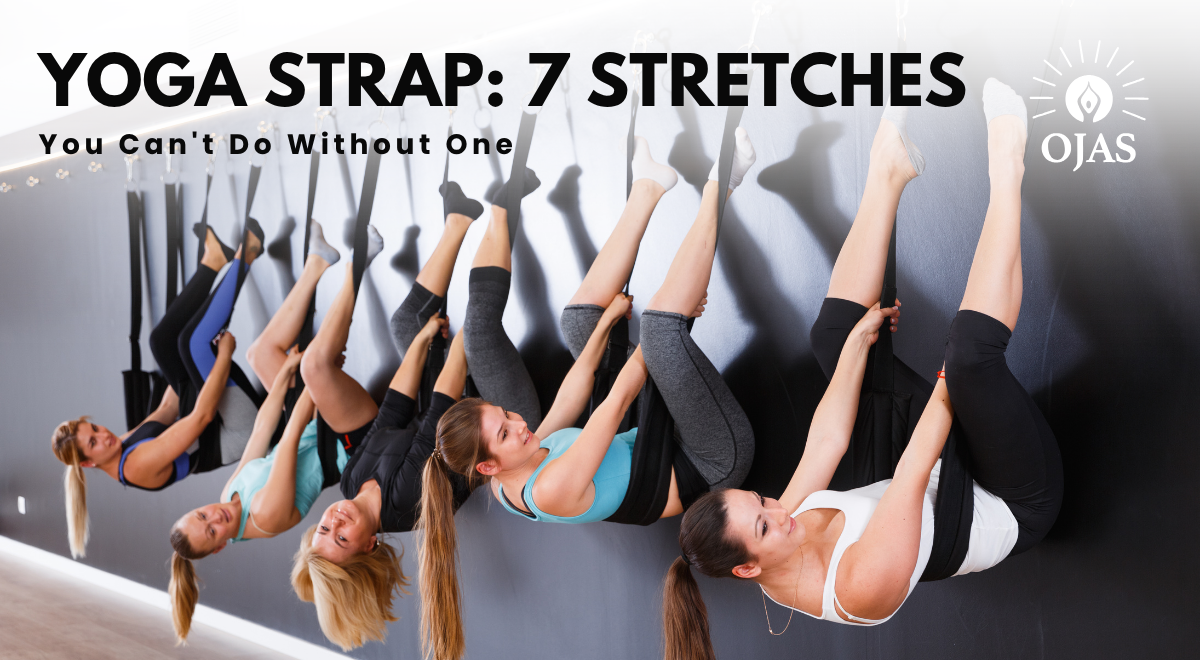
Watch someone reach for their toes in a seated forward fold and you can usually see the exact moment it goes wrong. The hands stretch forward, the toes stay just out of reach, and the whole back rounds into a hard curve to make up the difference. The stretch they feel after that is in the lower back, not the hamstrings they were aiming for. A six-foot loop of webbing fixes that problem almost immediately.
That is the entire case for a yoga strap. It is not a flexibility shortcut or a gadget. It is a way to borrow length you do not have yet, so you can hold a clean position and actually stretch the muscle you meant to, instead of cheating the shape with your spine.
What you need to know: A strap does not make you more flexible by itself. It lets you keep good form in stretches your current range cannot reach, which is what makes the flexibility come, safely and faster.
Below is what a strap actually does, the seven stretches where it earns its place, and how to pick one that suits you. If you are still assembling your kit, the studio’s rundown of basic yoga essentials covers where a strap sits among the gear that is genuinely worth owning.
What is a yoga strap, and why not a resistance band?
A yoga strap is a length of non-stretch cotton or nylon webbing, usually six to eight feet long, with a buckle or loop to fasten it. The non-stretch part is the whole point: unlike an elastic resistance band, it gives you a fixed, reliable line to pull against without springing back or adding force.
That difference matters more than it sounds. A resistance band is built to fight you; it loads the muscle by pulling back. A strap does the opposite. It stays put, so it can hold a position for you while the muscle relaxes into it. One is for building strength, the other for finding length. Reaching for a band when you want a deeper, calmer stretch is the most common mix-up, and it leaves people bouncing against tension rather than easing through it.
The strap is not a modern fitness invention either. It comes out of the Iyengar tradition of yoga, where props like straps, blocks, and bolsters were brought in precisely so that a stiffer or older body could hold a pose correctly instead of straining toward an idealized version of it. The strap was always about making the real shape available to a real body. That history is worth keeping in mind when it starts to feel like a crutch, which it is not.
If you would rather buy than improvise, you can find straps alongside the rest of the props in the studio’s shop. A knotted belt or dog leash will technically work in a pinch, but the flat webbing of a proper strap is far kinder on the hands.
Who benefits most from using a yoga strap?
A strap helps most anyone who cannot yet reach a position without compensating somewhere else in the body.
In practice that means people with tight hamstrings, restricted shoulders, stiff hips, longer limbs, posture tension from desk work, or anyone easing back into movement after a long break. The rule of thumb is behavioral, not anatomical: if you find yourself rounding your back to reach your feet, straining through the neck, or holding your breath to stay in a position, a strap will usually improve the stretch on the very first try.
One pattern we see often at Ojas Yoga is that practitioners assume they need deeper stretches when what they actually need is better positioning. A strap tends to solve the positioning problem first, before flexibility has even started to change.
How to use a yoga strap without forcing it
The method behind every strap stretch is simple: get into a supported position, create gentle active tension by drawing the strap toward you, breathe, and let the muscle release on the exhale before you take any more. You are coaxing length, not yanking for it.
There is a real technique underneath this, often called contract-relax or PNF, and it is genuinely effective. The short version: take the stretch to a comfortable edge, gently engage the muscle against the strap for a few seconds, then relax and breathe out, and you will usually find a little more range opening up on its own. The strap holds the new position so you never have to grip or strain to keep it. Pairing each movement with a slow exhale does most of the work, which is why a strap stretch and a deliberate breathing practice belong together.
It is easier to feel than to read. In the reclined hamstring stretch, draw the leg toward you until you reach a firm but comfortable stretch, then press your foot lightly down into the strap as if trying to lower the leg, holding that gentle push for about five seconds. Stop pushing, exhale slowly, and draw the leg a touch closer. The hamstring that was at its limit a moment ago usually gives you another inch without protest. That cycle, edge, brief contraction, release on the breath, is the whole method, and it works on every stretch in this guide.
One rule sits above all the others. Stop at sensation, not pain. A good stretch is a broad, tolerable pull you can breathe into. A sharp, pinpoint, or joint sensation is your cue to back off immediately. I have seen far more progress lost to one aggressive session than ever gained by it.
Practical implication: Spend two or three breaths at each depth before going further. The people who plateau are almost always the ones rushing the edges, not the ones who lack flexibility.
Simple version: Engage the muscle gently first, let the strap hold the position, then relax into it on the breath. The strap works best when it helps the body release, not when you use it to pull harder.
How long does it take to improve flexibility with a yoga strap?
Most practitioners notice better stretch positioning within the first week, while real flexibility gains usually show up after two to four weeks of consistent practice. Movement quality improves before range of motion does.
| Timeline | What tends to change |
|---|---|
| Week 1 | Better positioning and body awareness in each stretch |
| Weeks 2 to 3 | Reduced stiffness and easier, smoother movement |
| Week 4 and beyond | Many practitioners begin noticing measurable improvements in mobility and movement comfort |
The honest version: progress is rarely dramatic week to week, and it depends on how consistently you practice and how tight you were to begin with. Feeling looser and more in control is the early reward; bigger range follows it.
The 7 yoga strap stretches worth knowing
These seven cover the body’s most stubborn areas for desk-bound and athletic bodies alike: hamstrings, inner thighs, outer hips, spine, shoulders, chest, and the front of the hips. Each one uses the strap to hold a clean line you could not otherwise keep. Warm up first, even just a few rounds of an easy sun salutation, so you are stretching warm muscle.
Short on time? The reclined hamstring stretch, the seated forward fold, and the overhead shoulder opener are the three to keep. Together they hit the restrictions a desk-based life most reliably creates.
1. Reclined hamstring stretch
Target areas: Hamstrings, calves, posterior chain
Best for: Tight hamstrings and forward-fold limitations
Common mistake: Pulling with the shoulders or rounding the lower back
This is the stretch the strap was made for. Lie on your back, loop the strap around the arch of one foot, and hold an end in each hand. Extend that leg toward the ceiling, keeping a soft micro-bend in the knee, and draw it gently toward you using the strap, not your neck or shoulders. Keep the opposite leg long on the floor. Five to eight slow breaths, then switch. Tight hamstrings from long sitting respond especially well here, which is why this pairs naturally with a desk-recovery routine.
2. Reclined inner-thigh stretch
Target areas: Adductors, inner thighs, groin
Best for: Tight inner thighs and limited hip abduction
Common mistake: Letting the opposite hip lift off the floor
From the same setup, the strap lets you open the adductors without collapsing the pelvis. Staying on your back with the strap around one foot, let that leg open out to the side, both hands holding the strap on that same side. Lower only as far as you can while keeping both hips level on the floor. The strap carries the leg’s weight so the inner thigh can soften rather than grip. Hold, breathe, switch sides.
3. Reclined outer-hip and IT band stretch
Target areas: Outer hip, IT band, glutes
Best for: Runners and desk sitters with tight outer hips
Common mistake: Feeling it in the knee instead of the hip
The third direction of the reclined series reaches the outer hip and IT band that running and sitting both tighten. Back on the floor, strap around one foot, take that leg gently across the body toward the opposite side, switching the strap into the opposite hand. Keep both shoulders down. You should feel this along the outer thigh and hip, never in the knee. Ease off the moment it sharpens.
4. Seated forward fold
Target areas: Hamstrings, lower back, spine
Best for: Anyone who rounds the back reaching for the feet
Common mistake: Tucking the pelvis and curling the spine to reach
The strap turns a back-rounding forward fold into a genuine hamstring and spine stretch. Sit with both legs extended, loop the strap around the soles of both feet, and hold one end in each hand. Sit up tall first, then hinge forward from the hips, walking your hands down the strap only as far as you can while keeping the spine long. The strap means you stop rounding to reach. Length over depth, every time.
5. Overhead shoulder opener
Target areas: Shoulders, chest, upper back
Best for: Stiff shoulders and overhead-reach restrictions
Common mistake: Gripping too narrow and pinching the shoulder
For tight shoulders, the strap gives you a way to move through the full range without wrenching the joint. Stand or sit tall and hold the strap wider than shoulder-width in front of you, palms down. Keeping the arms straight, sweep the strap up and overhead, going only as far back as your shoulders allow with no pinching. Widen your grip if it is too tight. Move slowly, a few passes, breathing as you go.
6. Behind-the-back chest opener
Target areas: Chest, front of shoulders, biceps
Best for: Rounded-forward posture from screens and desks
Common mistake: Flaring the ribs instead of opening the chest
This one counters the rounded-forward posture that screens and desks build in. Hold the strap behind your back, one hand reaching down from above the shoulder and the other coming up from below, walking the hands toward each other along the strap as far as is comfortable. You will feel the chest and the front of the shoulder open. Keep the ribs from flaring and the neck soft. Switch which hand is on top after a few breaths.
7. Reclined quad and hip-flexor stretch
Target areas: Quadriceps, hip flexors
Best for: The short, tight front-of-hip that sitting creates
Common mistake: Arching the lower back to compensate
The front of the hips, chronically short from sitting, is hard to reach safely without help. Lying on your front or side, loop the strap around the top of one foot and draw the heel gently toward the same-side glute, using the strap rather than cranking with the hand. Keep the knees close together and the lower back from arching. This reaches the quadriceps and hip flexors that hours in a chair quietly shorten. Hold, breathe, release slowly.
Buyer takeaway: If you only own one prop, a strap opens up more of the body than any other single piece of gear, because it reaches the big posterior and hip muscles a block cannot.
Which yoga strap stretch should beginners start with?
If you are new to props, begin with the reclined hamstring stretch and the seated forward fold. They give the clearest feedback, carry the lowest injury risk, and improve movement quality fastest.
Once those two feel comfortable and you have the breathe-and-release rhythm, add the overhead shoulder opener and the reclined hip-flexor stretch before working through the full set. There is no prize for doing all seven on day one.
What are the most common mistakes with a yoga strap?
The recurring errors are pulling with the arms and shoulders instead of letting the strap hold the position, chasing depth at the cost of a long spine, holding the breath, and locking the joint under tension. Each one quietly cancels the benefit the strap is supposed to provide.
The first is the most common. People grip the strap and haul, recruiting the neck and shoulders, which tenses exactly the system that needs to relax for a muscle to release. The strap is meant to be a parking brake, not a winch. Set the position, then soften your hands and let the webbing hold it.
Chasing depth is the next trap. A strap exists so you can keep a long spine in a forward fold or a square pelvis in a leg stretch; trading that good line for an extra few inches of reach defeats the entire purpose and sends the load back into your lower back. Hold the cleaner, shallower version and let depth arrive on its own.
The last two go together. Holding your breath flips the body toward its guarding response, so the muscle resists rather than lengthens, and locking a knee or elbow to full straightness under tension puts the strain into the joint instead of the muscle. Breathe steadily, keep a micro-bend, and you sidestep both at once.
When should you avoid deep strap stretching?
A strap improves safety, but it does not override pain signals. Skip deep assisted stretching if you have an acute muscle strain, a recent surgery, significant joint inflammation, active nerve symptoms, or any sharp pain you cannot explain.
The clearest stop signs are neurological. If stretching consistently brings on numbness, tingling, pain that radiates down a limb, or a joint that feels unstable, that is not tightness to work through; it is a reason to get assessed before you go further. A strap makes a stretch more controlled, not immune to injury.
How do you know if you actually need a strap?
The strongest signals are simple: you round your back to reach in forward folds, you cannot hold a stretch without gripping or wobbling, or your range has not budged in weeks despite stretching regularly. Each of those is usually a reach-and-control problem, exactly what a strap solves.
Rounding is the clearest tell. If your spine curves to compensate for tight hamstrings or hips, you are loading the back instead of lengthening the target muscle, and no amount of repetition will fix it. The strap gives you the few extra inches that let the spine stay long. Form first, then depth, is the same principle that runs through any solid beginner alignment practice.
A plateau is the other common reason people reach for one. When a muscle has been stretched to the same self-limited edge for weeks, it stops adapting. A strap, used with the breathe-and-release method above, lets you hold a slightly deeper position with control, which is often all that is needed to start moving again. The protection it offers against overstretching matters too, and that injury-prevention angle is part of the broader case for controlled, supported movement.
Can a yoga strap improve flexibility faster?
A strap does not force flexibility, but it often speeds progress by improving stretch quality and cutting out the compensations that waste a stretch.
The mechanism is straightforward. When your spine rounds or your hip hikes to reach a position, much of the stretch leaks into those compensating areas instead of the muscle you meant to target. Holding a clean line sends the load where it belongs, so each session does more, and consistent sessions add up sooner.
Can a yoga strap improve posture?
A strap can improve posture indirectly, by restoring mobility to the shoulders, chest, hips, and spine so that standing tall takes less effort.
Most posture problems are not a failure of willpower. They come from movement restrictions that make a good upright position genuinely hard to hold. Free up the tissue that is pulling you into a slump and the posture stops being a constant act of holding yourself up. This is especially true for desk workers, whose tight chest, restricted shoulders, and short hip flexors quietly fight every attempt to sit and stand tall.
How do you choose the right yoga strap?
For most practitioners, a six-foot cotton strap with a cinch or D-ring buckle covers everything in this guide. Taller practitioners or anyone doing a lot of overhead and behind-the-back work will prefer an eight-foot length, and dedicated stretchers sometimes add a multi-loop strap for hands-free holds.
Length is the first decision. Six feet suits the average height and the reclined leg series; eight feet gives more room for shoulder work and for wrapping around both feet in a seated fold. When in doubt, longer is more forgiving, since you can always gather the slack.
Material and buckle are the rest of it. Cotton or a cotton blend is the standard for a reason: it grips well and is soft on the hands. The buckle is mostly preference. A metal D-ring holds firmly and is quick to cinch; a plastic cinch buckle is lighter; a sewn loop strap has fixed handholds that some find easier for assisted stretches. None of these will make or break your practice. Buy one, use it for a month, and you will know what you actually want. A cotton strap also washes easily, a cold machine wash and air dry, which is worth knowing once it has soaked up a few months of practice. Straps and the other genuinely useful props are in the shop if you would rather not guess.
Learn to use yoga props correctly
Plenty of people own a yoga strap and never learn to use it well, which is how it ends up in a drawer instead of a practice.
At Ojas Yoga and Wellness, props are built into classes, private sessions, and Yoga Therapy and mobility programs as tools for movement education, not as shortcuts to advanced poses. An instructor can see the compensation you cannot feel, and adjust where the strap sits, how you are pulling, and which version of a stretch actually fits your body today. Whether the goal is flexibility, recovery, posture, or long-term mobility, good positioning is what makes progress stick.
One pattern instructors notice constantly is that students assume flexibility is the missing piece when the real limiter is alignment. A strap helps tell those two apart, showing whether a position is restricted by genuine tissue length or simply by inefficient mechanics. That diagnostic value is a large part of why it stays one of the most useful teaching tools in the room.
Common questions about yoga straps
Is using a yoga strap cheating?
No. A strap is an alignment tool, not a sign of weakness. It lets you hold a correct position your current flexibility cannot yet reach, which is how you build that flexibility safely rather than by forcing and risking strain.
The idea that props are for the inflexible has it backwards. Experienced practitioners use straps constantly, because better positioning produces a better stretch at every level.
How long should you hold a strap stretch?
Five to eight slow breaths, roughly thirty to sixty seconds, is a good general hold for most strap stretches. Longer, gentler holds suit tight or stubborn muscles; the key is staying relaxed enough to breathe smoothly the entire time.
If you find yourself holding your breath or gritting through it, you have gone too deep. Ease back until the breath flows again.
Can beginners use a yoga strap?
Yes, and beginners often benefit the most. A strap makes the foundational stretches accessible from day one, without the rounding and straining that discourage new practitioners and occasionally injure them.
It also teaches the feel of a good stretch early: supported, breathable, and free of the gripping that comes from reaching past your range.
Is a yoga strap the same as a resistance band?
No. A resistance band is elastic and adds load to build strength; a yoga strap is non-stretch and provides a fixed line to deepen and hold stretches. They are different tools for different jobs and are not interchangeable.
If your goal is length and control rather than resistance, the strap is the right pick every time.
What length yoga strap should I buy?
A six-foot strap suits most practitioners, while taller practitioners and anyone focused on shoulder work tend to prefer eight feet. If you are unsure, choose the longer one, since extra length is far easier to manage than a strap that comes up short.
You can always gather the slack on a longer strap; you cannot add length to a short one mid-stretch.
What can I use if I do not have a yoga strap yet?
A long bathrobe belt, a luggage strap, an old necktie, or a dog leash will all stand in for a yoga strap, since the only real requirement is that the material does not stretch.
Avoid anything elastic, which defeats the purpose, and anything thin and ropelike, which cuts into the hands. A flat, wide band is the most comfortable improvisation until you buy a proper one.
Build better mobility, not deeper stretches
A yoga strap is not a shortcut to flexibility. It is a tool that improves positioning, reduces compensation, and helps the body move through a greater range with control.
For most practitioners the breakthrough is not learning to stretch harder; it is learning to stretch more intelligently. Small improvements in alignment tend to create larger long-term changes than pulling deeper into a position ever will. Props, used this way, are there to make poses smarter, not merely easier.
Start with one stretch, practice it consistently for a week, and focus on quality over depth. Mobility rarely improves because people push harder. It improves because they learn to move better.
If you are unsure which stretches or props suit your body, working with a qualified instructor can often reveal in a single session what takes months to find on your own.


