
Six weeks after giving birth, most mothers in Singapore are told they can “start exercising again”, and almost nobody explains what that means for a body that has just grown and delivered a baby. Your pelvic floor is weaker than it feels. Your abdominal wall may still be separated. If you had a caesarean, there is a healing wound under the skin that you cannot see. Postnatal yoga can help with all of this, but only if it starts at the right point and progresses in the right order.
This guide covers three questions in turn: when you can start, which practices are safe at each stage, and where in Singapore you can practise, from hospital physiotherapy to studio classes and one-to-one sessions. It follows the postpartum guidance published by the American College of Obstetricians and Gynecologists (ACOG) and Singapore’s public hospitals, and it reflects how our instructors adapt sessions for students returning to yoga after birth.
Before You Start: Postnatal Safety Basics
Get clearance from your gynaecologist or GP before returning to any yoga class, and stop and seek medical advice if you notice heavy or returning bright red bleeding, pain or discharge from a caesarean wound, chest pain, calf pain or swelling, or a feeling of heaviness or bulging in the vagina.
These warning signs come first because they are the ones that matter in the weeks after birth. Some bleeding, called lochia, is normal: it is heaviest in the first few days and can last up to four to six weeks. Bleeding that increases after exercise is a sign you have done too much too soon. Calf pain or breathlessness can signal a blood clot, a risk that stays raised for several weeks after delivery. A dragging or heavy sensation in the pelvis can be an early sign of prolapse, which is far easier to manage when it is caught early.
The routine postnatal check, which KK Women’s and Children’s Hospital’s advice for new mothers places at around six weeks after delivery, is the natural point to ask about exercise. Go in with specific questions rather than a general “can I exercise?”: ask whether your pelvic floor and abdominal muscles have recovered, whether your caesarean wound has healed, and whether a referral to a women’s health physiotherapist would help.
When Can You Start Postnatal Yoga?
Gentle breathing and pelvic floor exercises can usually start within days of an uncomplicated birth; a gentle postnatal yoga class usually begins after your six-week postnatal check; and a full return to your previous practice typically takes three to six months or longer.
ACOG’s 2020 committee opinion on physical activity in pregnancy and the postpartum period says exercise can be resumed gradually after birth, as soon as it is medically safe, and that the right timing depends on the type of delivery and any complications. Many women who had an uncomplicated vaginal birth are able to begin gentle activity within days. Singapore’s public hospitals give similar advice: new mothers are encouraged to start pelvic floor exercises early, and to wait for their postnatal review before taking up a structured exercise programme. The table below sets out what that looks like in practice.
| Time since birth | What is usually appropriate | What to hold off on |
|---|---|---|
| First days to 2 weeks | Diaphragmatic breathing, gentle pelvic floor contractions, short walks at home | Any class, abdominal exercises, lifting anything heavier than your baby |
| Weeks 2 to 6 | Seated and lying breathwork, gentle neck and shoulder release, pelvic tilts, longer walks | Group classes, core work, deep stretches, inversions |
| Weeks 6 to 12 (after clearance) | Gentle postnatal or beginner yoga, supported poses, gradual core reconnection | Full planks, crunches, deep backbends, hot yoga, jumping |
| 3 to 6 months | Gradual return to standing strength, longer holds, more challenging flows | Advanced inversions and arm balances until core and pelvic floor feel strong |
| 6 months and beyond | Most of your previous practice, progressed at your own pace | Anything that causes leaking, pain or abdominal doming |
Treat these as typical ranges, not deadlines. A difficult delivery, a third or fourth-degree tear, heavy blood loss, anaemia or a caesarean section will push every stage later. Equally, someone who practised yoga regularly through pregnancy may move through the early stages faster than a beginner.
Vaginal birth
After an uncomplicated vaginal birth, breathing and pelvic floor work can start as soon as it feels comfortable, often within the first few days. If you had stitches, wait until sitting is comfortable before adding seated practice, and avoid wide-legged poses that pull on the perineum until it has healed.
Caesarean section
A caesarean is major abdominal surgery, and recovery from it takes longer. Breathing and gentle pelvic floor work can still begin early, because they do not strain the wound. Most women are advised to avoid lifting anything heavier than their baby, and to stay away from abdominal exercises, for at least six weeks. Hold off on twists, deep backbends and anything that stretches across the scar until your doctor confirms it has healed. Your pelvic floor still needs attention after a caesarean: surgeons at Singapore General Hospital point out that a C-section does not necessarily protect the pelvic floor, because pregnancy itself puts strain on those muscles.
Can You Do Postnatal Exercise During Confinement?
Yes, the exercises that matter most in the first month, breathing and pelvic floor work, fit easily within confinement because they need no travel, no sweating and very little space.
Many families in Singapore observe a confinement period after birth. HealthHub puts it at 30 days in Chinese tradition, 40 days in Indian tradition and 44 days of pantang in Malay tradition. Some confinement customs discourage going out, bathing often or exerting yourself, and mothers sometimes assume that rules out exercise entirely. It does not. KKH’s advice for new mothers asks them to rest and relax during confinement, and in the same breath encourages postnatal exercise to firm up the abdomen, hips and thighs, plus pelvic floor exercises to prevent leaking urine. Nothing in this early-stage work conflicts with resting at home.
In practice, confinement lines up well with what your body needs anyway. The first month is for rest, recovery and reconnecting with the deep core and pelvic floor muscles, not for classes. Five to ten minutes of lying or seated breathing, a few sets of pelvic floor contractions spread across the day, and gentle neck and shoulder releases between feeds are enough. When confinement ends, you will be close to your postnatal check and ready to take the next step.
What Is Safe in Postnatal Yoga?
Safe postnatal yoga rebuilds from the inside out: breath and pelvic floor first, then deep abdominal connection, then posture and strength, with deep stretching and heavy core loading left until last.
Three physical changes shape every postnatal modification. First, the pelvic floor has been stretched by nine months of carrying weight and, for many women, by delivery itself. Second, the abdominal muscles have separated to some degree to make room for your baby, a condition called diastasis recti, and they take time to draw back together. Third, joints may stay looser than usual for some months after birth, and many mothers find this lasts longer while breastfeeding, so the stretch that feels easy may be past your safe range.
Practices that usually suit the early weeks
- Diaphragmatic breathing. Breathing into the sides and back of the ribs, then gently drawing in the lower belly and lifting the pelvic floor on the exhale, re-establishes the link between breath and deep core. It is the foundation for everything else.
- Pelvic tilts. Lying on your back with knees bent, rocking the pelvis gently to flatten and then arch the lower back. This mobilises a back that is often stiff from pregnancy and feeding.
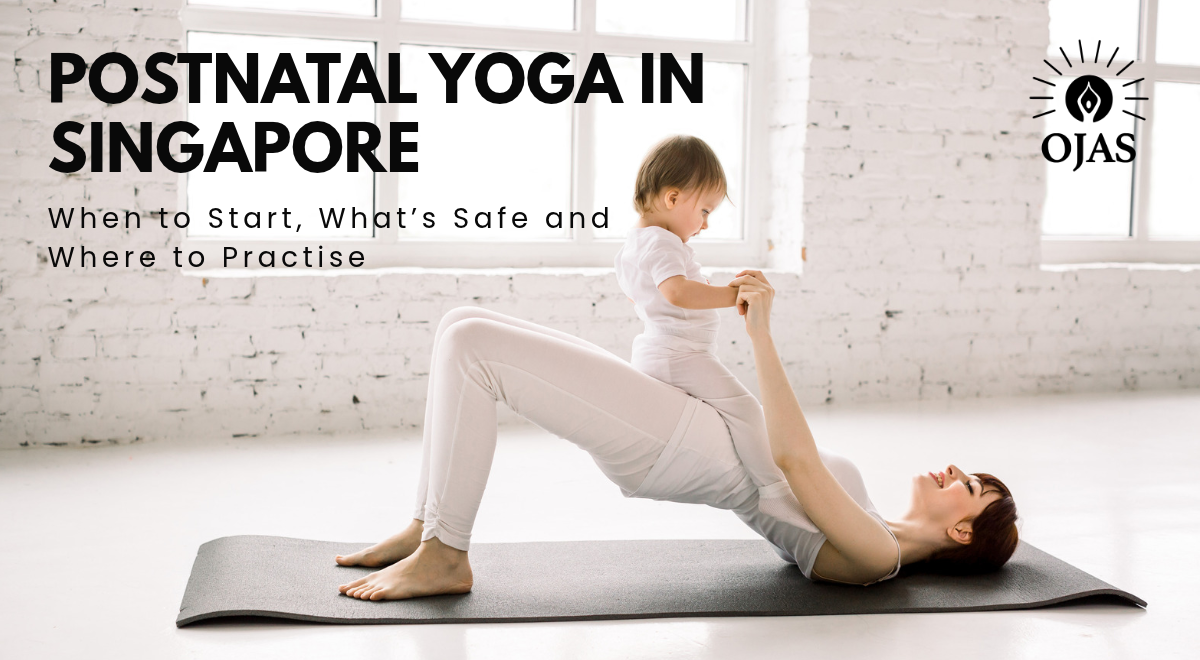
- Supported Bridge. Lifting the hips a short way, with an exhale and a gentle pelvic floor lift, strengthens the glutes without loading the abdominal wall.
- Cat-Cow on hands and knees. Slow spinal movement that eases upper back tension from carrying and feeding. Keep the belly from sagging fully on the “cow” phase.
- Supported Child’s Pose and side-lying rest. Rest positions count as practice in the postnatal months, especially on nights of broken sleep.
Practices to delay until your core and pelvic floor are ready
- Crunches, sit-ups and full boat pose. These push the abdominal contents forward and can widen a separation that is trying to close.
- Full planks and Chaturanga. They place heavy load on the abdominal wall. Start on the knees or against a wall, and progress only when there is no doming along the midline.
- Deep backbends. Wheel and full Camel stretch an abdominal wall that is still recovering, and a caesarean scar along with it.
- Inversions and arm balances. Headstand, shoulderstand and Crow can wait until you have rebuilt core strength, often several months after birth.
- Jumping transitions and hot yoga. Impact strains a weak pelvic floor, and heat adds strain to a body that may also be producing breast milk.
Your body gives clear signals when something is too much. Leaking urine, a feeling of pressure or heaviness in the pelvis, a ridge or dome along the centre of the belly, or pain in the scar or lower back all mean the same thing: regress to an easier version and build up again more slowly.
How Do You Check for Diastasis Recti?
The simplest sign is doming: if a ridge or cone appears along the middle of your belly when you lift your head from lying, or when you get up from bed, your abdominal muscles are still separated and core exercises need modifying.
To check, lie on your back with your knees bent, place your fingertips just above your belly button, and lift your head and shoulders slightly. A gap you can press your fingers into, or a soft dome bulging up between the muscles, suggests a separation. Some separation is normal in the early weeks, and many close substantially on their own in the first few months.
A self-check is a guide, not a diagnosis. If the gap feels wide, deep or soft, or doming persists past three months, ask your doctor for a referral to a women’s health physiotherapist, who can measure it properly and set exercises for your specific case. Postnatal yoga then works alongside that plan rather than replacing it.
Postnatal Yoga, Pilates or Physiotherapy: Which Do You Need?
If you have leaking, pelvic heaviness, pain or a wide abdominal separation, start with a women’s health physiotherapist; if you are recovering without those symptoms, postnatal yoga or Pilates is a reasonable place to begin.
The three overlap but do different jobs. A physiotherapist diagnoses and treats specific problems such as incontinence, prolapse, pelvic pain or significant diastasis recti, often with internal assessment and individual exercise prescriptions. Postnatal Pilates focuses heavily on controlled core strengthening. Postnatal yoga covers similar ground through breath-led movement, and adds what many new mothers say they need most: relaxation, better sleep when sleep is available, and space to slow down.
Many mothers use more than one. A common pattern in Singapore is a few physiotherapy sessions to sort out the pelvic floor, followed by yoga once the basics are in place. If back pain from feeding and carrying is your main complaint, the Cat-Cow and Child’s Pose in the sequence further down are a gentle place to start once your doctor has cleared you for exercise, and yoga therapy can address pain that persists.
Where to Practise Postnatal Yoga in Singapore
Start with hospital physiotherapy if you have symptoms that need medical care, then move to studio classes where an instructor adapts each pose to your recovery: one-to-one sessions first, then group classes once your core and pelvic floor feel reliable, with short home practice in between.
Hospital women’s health physiotherapy
KK Women’s and Children’s Hospital and Singapore General Hospital both run physiotherapy services for women after birth. At SGH, ward physiotherapists teach pelvic floor exercises to new mothers, and its Postnatal Assessment Service follows up mothers at higher risk of pelvic floor problems, such as those who needed forceps or had a serious perineal tear. KKH’s advice for new mothers also mentions postnatal exercise classes held at the hospital on weekends. Access to hospital physiotherapy usually goes through your obstetrician, so ask about it, and about current class dates, at your postnatal check.
Studio classes at Ojas
Ojas does not run a separate postnatal class. Students returning after birth join our regular studio classes instead, and the instructor adapts each pose to their stage of recovery. Which class suits you depends on how long it has been since birth and what you need most right now.
- Private yoga, from your postnatal check. One-to-one sessions are the most direct way to practise around a specific recovery: a caesarean scar, a diastasis recti gap, a pelvic floor that leaks when you jump, or a schedule set by feeds and naps. A private yoga class lets your instructor build each session around how your recovery is going that week.
- Couple yoga sessions. A private session for two lets you practise with your partner or a friend, which makes it easier to protect the time in a busy household.
- Yoga therapy, if pain is part of the picture. Yoga therapy sessions address specific concerns such as back pain, neck pain and stress, which suits mothers with discomfort from feeding, carrying and broken sleep.
- Group yoga classes, usually from about three months. Our group yoga classes run for about an hour and welcome beginners and returning practitioners. Tell the instructor that you are postnatal and how many weeks it has been, set up near the back so you can modify freely, and skip any pose on the “delay” list above without guilt.
- Ojas SpineCare, for back pain that lingers. Ojas SpineCare is a four-week programme focused on back pain and spinal health. Consider it once your doctor has cleared you for exercise and the early recovery weeks are behind you.
- Mid-Day Reset: Breathwork and Sound Bath. A lunchtime session at OUE Downtown Gallery built around gentle guided breathing and a sound bath, open to complete beginners. The Mid-Day Reset suits mothers who are back at work in the CBD and short on time.
- MBSR, for stress and overwhelm. Our eight-week MBSR course combines mindfulness meditation with gentle movement. It is not a treatment for postnatal depression, but it can be a useful support alongside care from your doctor.
At home
For many mothers, the realistic practice is ten minutes on the living room floor while the baby naps. That is enough in the early months. Breathing, pelvic tilts, Bridge and Cat-Cow done regularly will do more for your recovery than an occasional long class. If you want guidance without travelling, online yoga classes are an option.
Location matters more than usual in this season, because every trip has to fit around feeds. Ojas has three studios in Singapore, at Joo Chiat in the east, OUE Downtown Gallery on Shenton Way in the CBD, and Serangoon Road. Weekday hours run from 7am to 9pm and weekend hours from 8am to 6pm, so you can book around your partner’s schedule or the baby’s longest nap.
A Gentle 15-Minute Postnatal Sequence to Start With
Once your doctor has cleared you for exercise, this short sequence covers breath, pelvic floor, spine and rest in about fifteen minutes, and it needs only a mat and a pillow.
- Breathing, 3 minutes. Lie on your back with knees bent and feet flat. Breathe into your ribs, then on each exhale gently lift the pelvic floor and draw the lower belly in. Release fully on the inhale.
- Pelvic tilts, 2 minutes. In the same position, rock the pelvis to flatten the lower back on the exhale, then return to neutral on the inhale. Keep the movement small.
- Supported Bridge, 2 minutes. Exhale, lift the pelvic floor and raise the hips a few centimetres, then lower slowly. Do 6 to 8 slow repetitions.
- Cat-Cow, 3 minutes. On hands and knees, move slowly through the spine, keeping the belly gently supported. This eases the rounded upper back that comes from feeding.
- Child’s Pose with knees wide, 2 minutes. Rest your forehead on a pillow and breathe into your back.
- Side-lying rest, 3 minutes. Lie on your side with a pillow between your knees and let your body be still.
If any step causes leaking, pelvic pressure, doming or pain, skip it and mention it at your next medical appointment. On harder days, step 1 on its own, a few minutes of slow breathing, still counts as practice.
Frequently Asked Questions
Can I do postnatal yoga while breastfeeding?
Yes. ACOG notes that regular moderate exercise does not affect milk supply. Feeding or expressing before you practise makes belly-down and forward-folding positions more comfortable, and a supportive bra helps. Drink water before and after, as feeding and exercise both increase how much fluid you need.
How long after a C-section can I do yoga?
Breathing and gentle pelvic floor work can usually begin within days. Most women wait at least six to eight weeks, and until their doctor confirms the wound has healed, before joining a gentle class. Twists, deep backbends and direct abdominal work come later still, and should build up gradually.
Is it too late to start postnatal yoga at six months or a year?
No. Pelvic floor and abdominal muscles respond to training long after the postnatal period, and many women first notice leaking or a persistent separation months after birth. The same principles apply: start with breath and pelvic floor, check for doming, and progress gradually.
Can postnatal yoga help with low mood after birth?
ACOG’s guidance notes that physical activity can help prevent depressive symptoms after birth, and many mothers find that breath-led practice helps them slow down. Yoga does not replace medical care, though. If low mood, anxiety or intrusive thoughts last longer than two weeks, or feel overwhelming, speak to your GP or obstetrician promptly. If you have thoughts of harming yourself, call the Samaritans of Singapore 24-hour hotline on 1767, message their 24-hour CareText service on WhatsApp at 9151 1767, or go to the nearest emergency department.
When can I go back to my regular yoga class?
Most women return to a general class between three and six months after birth, once they can hold a modified plank without doming or leaking and their pelvic floor feels reliable. Tell your instructor you are postnatal, and expect stronger flows and inversions to come back over several more months.
I practised prenatal yoga. Does that make postnatal recovery faster?
Often it helps, because the breath awareness and pelvic floor connection you built during pregnancy are the starting point for postnatal work. Your body has still been through birth, though, so begin at the first stage rather than where your prenatal practice left off. Our guide to prenatal yoga by trimester shows how those foundations are built.
Returning to Yoga at Your Own Pace
Postnatal recovery does not follow a straight line. Some weeks you will feel stronger than you expected, and other weeks broken sleep will wipe out any plan to practise. Both are normal. What matters most is the order: breath and pelvic floor first, then core, then strength, then everything else.
If you would like an instructor to guide that progression, we do not ask you to fit into a fixed postnatal programme. Our instructors adapt one-to-one sessions, yoga therapy and group classes to your recovery, your delivery and your baby’s schedule at any of our three studios. Bring your doctor’s clearance and your questions to the first session, and we will start from where your body is now.


