
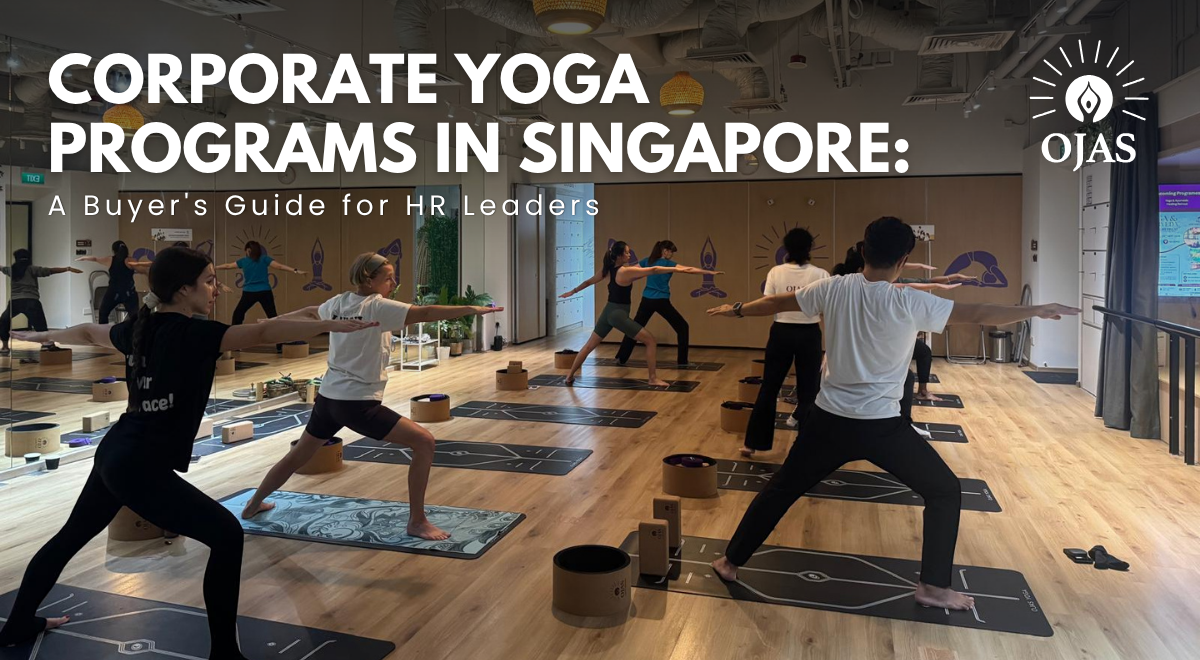
Someone in leadership decides the company needs a wellness benefit, and it lands on HR to make it happen. Three vendors send proposals with different formats, different pricing structures and no shared way to compare them. None of the proposals mention what happens if the instructor is sick, who is liable if someone tweaks a shoulder, or how you will explain the spend at the next budget review.
This guide is written for that moment. It is not about which yoga poses suit an office, and it does not try to sell you on the case for wellness; our guide to corporate yoga’s benefits and ROI already covers that ground for the leadership conversation. This one covers the purchasing decision itself: the formats on offer, how pricing actually works, what to put in a vendor checklist, the contract terms worth confirming before you sign, and how you prove afterwards that the programme did what it was bought to do. For the full picture of what a programme with Ojas looks like day to day, our corporate wellness programme page is the overview this guide sits underneath.
What are you actually buying? The four formats corporate yoga comes in
Every proposal you receive will be a variation on one of four delivery formats. Knowing which one you need before you take calls saves you from comparing quotes that are not comparable.
| Format | How it works | Best fit | Main trade-off |
|---|---|---|---|
| Onsite, instructor-led | A yoga teacher comes to your office on a fixed day and time, using a meeting room, break-out space or rooftop | Single-location teams with a bookable space and consistent headcount | Needs a room and mats; cancels if the space is double-booked |
| Virtual, live-streamed | A teacher runs a live session over video call at a scheduled time; employees join from their desk or home | Distributed or hybrid teams, remote staff, multiple offices on one programme | Lower attendance discipline; needs a quiet spot and a screen |
| Hybrid | A mix of onsite sessions for the main office plus a virtual stream for remote or satellite staff | Companies with one HQ and smaller remote teams | Two things to coordinate and two attendance patterns to track |
| Flexible credits / aggregator | Employees redeem a monthly credit at partner studios of their choice, rather than one scheduled group class | Companies that want variety and no fixed timetable | Weakest team-building effect; harder to verify who actually used it |
Most HR teams default to onsite because it is the easiest to picture, but the right choice depends on where your people actually sit. If your workforce is split between mat-based movement and desk-bound roles that cannot easily leave their seats, our desk yoga versus mat yoga guide walks through that specific decision.
How is corporate yoga priced in Singapore, and which model should you choose?
Providers generally price a programme one of four ways, and the model matters more than the headline number because each shifts the risk differently.
- Per-session booking. You pay for each class as it happens. Flexible, but the first thing cut when a quarter gets busy, and pricing is rarely locked in.
- Prepaid class package. A block of sessions bought upfront at a set rate, used within a validity window. Predictable cost, but you carry the risk if uptake is lower than planned.
- Monthly retainer. A fixed weekly or twice-weekly slot billed monthly, usually with a minimum commitment period. This is the model most onsite corporate programmes settle on, because it guarantees the instructor a recurring booking and guarantees you a fixed cost to budget against.
- Per-employee platform licence. Common with aggregator-style flexible-credit providers, priced per enrolled headcount rather than per class delivered.
Ask every vendor to quote against the same three variables: your headcount, your intended frequency, and your chosen format. A quote that looks cheaper per session can still cost more overall once you compare it on cost per employee who actually attends each month, rather than cost per class booked. A studio charging more per session but running full classes usually beats a cheaper provider running half-empty ones.
Studio, freelance instructor or platform: who should actually run the sessions?
| Provider type | Backup if instructor is unavailable | Insurance | Customisation |
|---|---|---|---|
| Yoga studio or wellness company | Usually has a bench of instructors to cover absence | Typically carries public liability cover as part of doing business | Can tailor sequences for desk workers, injuries or pregnancy across a team of teachers |
| Independent freelance instructor | Often none; the session is simply cancelled | Varies; confirm before booking, do not assume | Personal to that one teacher’s style and experience |
| Flexible-credit platform | Not applicable; employees book individually | Handled by the partner studio the employee visits | None at company level; each employee picks their own class |
A studio-run programme costs more per session than booking a freelancer directly, but the difference is usually the cover, the insurance and the single point of accountability, which matters more once a programme runs for a full year rather than a single trial month. Admin load follows the same pattern: a studio gives you one contact for scheduling, invoicing and cover, a freelancer makes HR the fallback for both, and a platform needs almost no ongoing admin but gives you little visibility into who is actually using it.
What should be on your vendor evaluation checklist?
Whether you run a formal RFP or a few structured calls, ask every vendor to answer the same list so proposals are comparable side by side:
- Instructor certification and experience with beginners, office settings and common conditions such as bad backs or pregnancy, not just years of teaching generally.
- Backup arrangements. What happens to your booked slot if the instructor is unwell, and how much notice do you get?
- Public liability insurance. Ask to see it, do not take it as read.
- Space and equipment requirements. Minimum room size, mat provision, and whether they bring props or expect you to supply them.
- Group size limits. Minimum viable class size and the maximum one instructor can safely run.
- Health screening or consent. How injuries, pregnancy or existing conditions are flagged before a session, and whether the instructor adapts on the spot or expects prior notice.
- Cancellation and rescheduling policy, from both sides: what happens if your office cancels a session, and what happens if they do.
- Reporting. Whether they can give you attendance numbers you can actually use for the review meeting, not just an invoice.
If you are choosing between two or three shortlisted vendors rather than building the process from scratch, our guide to choosing a corporate yoga class goes deeper on evaluating instructor credentials and running a useful trial session.
What contract terms should HR confirm before signing?
Beyond the checklist above, four terms in the contract itself are worth reading closely rather than skimming to the price:
- Minimum commitment period. Many retainer contracts lock you in for three to six months. Confirm what happens if the programme is not working and you need to exit early.
- Price lock-in. Ask how long the quoted rate holds, and whether it rises automatically on renewal or requires a fresh negotiation.
- Liability allocation. Confirm in writing whether the vendor’s insurance covers participant injury during the session, or whether your own corporate insurance is expected to carry that risk.
- Data handling. If sign-ups or attendance run through an app or booking form, confirm what employee data is collected and where it is stored, particularly for a programme open to all staff.
None of this needs to slow the process down. Most established providers already have answers ready; the point of asking upfront is finding out before your first session, not after something goes wrong.
How do you measure whether the programme is working?
Once a programme is running, HR needs numbers for the next budget conversation. Three are worth tracking from week one rather than reconstructing later:
- Uptake rate, meaning attendees as a share of eligible headcount, not just raw attendance counts, which look healthy even when the same handful of people show up every week.
- Attendance trend over time. A programme that starts strong and fades by month three signals a scheduling or format problem worth fixing before renewal, not a reason to cancel outright.
- A short pulse survey after the first four to six weeks, asking whether the timing, format and difficulty level actually suit the team, rather than assuming the launch plan got it right.
These attendance numbers answer whether the programme is being used. They are also what your provider should already have a template for; ask about reporting during vendor evaluation, not after month three.
How do you launch without a low first turnout?
The most common reason a well-chosen programme fails is a quiet launch, not a bad vendor. A few things reliably help:
- Get a visible manager to attend the first session. Teams follow their manager’s lead on whether a benefit is really sanctioned or just nominally offered.
- Announce the format and timing at least two weeks ahead, not the morning of the first class, so people can actually plan around it.
- Run one trial session before committing to a retainer. A single paid trial class tells you more about real uptake than any proposal will.
- Pick a time that does not compete with lunch or the commute unless you have already confirmed that is when your team wants it; a mid-afternoon slot often gets better sustained attendance than one squeezed into a lunch hour.
Common mistakes HR teams make when buying corporate yoga
- Choosing purely on price per session. A cheaper class that runs half-full costs more per attending employee than a pricier one that fills up.
- Skipping the trial class. A single trial session catches format and fit problems that no proposal document will surface.
- No written backup-instructor clause. Without one, a single sick day quietly becomes a cancelled month.
- Choosing one format for a genuinely hybrid workforce. Onsite-only programmes lose remote and satellite-office staff before the programme even starts.
- No attendance tracking from day one. Reconstructing uptake data for a renewal decision three months in is far harder than logging it from the first class.
Common questions HR leaders ask
What is a reasonable minimum group size for onsite corporate yoga?
Most providers can run a session for as few as six to eight people, though the exact minimum varies by vendor. Below that, per-person cost usually rises sharply enough that a flexible-credit format becomes more economical than a dedicated onsite slot.
Can one programme cover employees across multiple office locations?
Yes, typically through a hybrid or fully virtual format, or by running separate onsite slots at each site under one contract. Confirm during vendor evaluation whether pricing is per location or per total headcount, since this changes which format is more cost-effective.
Do we need our own insurance, or does the vendor’s cover us?
This should be confirmed in writing before signing, not assumed. Established studios typically carry public liability insurance covering participant injury during sessions; independent freelancers do not always carry the same cover, which is one reason studio-run programmes suit larger, longer-running commitments.
How long is a typical contract, and can we exit early if it is not working?
Retainer contracts commonly run three to six months at a time. Ask specifically about the exit terms before signing, since this is the clause most often skipped in the excitement of launching a new benefit.
Should remote or work-from-home employees be included in the same programme?
If a meaningful share of your team works remotely, a hybrid or virtual format keeps the benefit equitable rather than limited to whoever happens to sit in the main office. Excluding remote staff from a wellness benefit tends to surface as a fairness complaint faster than almost any other rollout issue.
What happens if attendance is consistently low?
Low attendance is usually a timing, format or communication problem rather than a sign employees do not want the benefit. Before cancelling, check the uptake rate against a pulse survey; a change in time slot or a manager visibly attending often recovers a struggling programme faster than switching vendors.
Ready to put this framework in front of a vendor?
Ojas Yoga & Wellness runs corporate programmes across Singapore for teams including Mandarin Oriental, Citibank, Yale-NUS and the Singapore Prison Training Institute, in onsite, hybrid and virtual formats, with instructor cover built in rather than treated as an afterthought. You can review our corporate wellness programme details and request a proposal scoped to your headcount, format and budget model.


