Most lists of yoga poses to avoid during pregnancy stop at “don’t”. That leaves you standing on your mat halfway through a class, unsure what to do while everyone else moves into Wheel. A better question is what each risky pose was doing for your body, and which safer version gives you the same benefit. Almost every pose that needs to go has a pregnancy-friendly alternative that keeps the strength, stretch or rest it was there to provide.
This guide groups the poses that need avoiding or modifying by the reason behind them, shows from which stage each applies, and gives a specific alternative for each. It follows the physical activity guidance of the American College of Obstetricians and Gynecologists (ACOG) and reflects how our instructors adapt poses in prenatal yoga classes in Singapore.
Before You Start: Safety Comes First
If you have pregnancy complications, a medical condition or questions about exercising, speak to your obstetric care provider before practising, and stop immediately if you notice bleeding, dizziness, chest pain, painful regular contractions or leaking fluid.
ACOG’s 2020 committee opinion on physical activity in pregnancy encourages women with uncomplicated pregnancies to stay active and lists modified yoga among the activities considered safe. The word that matters is “modified”. The poses below are the ones that need modifying, and some conditions, such as placenta praevia after 26 weeks or cervical insufficiency, call for stricter limits that only your doctor can set.
Yoga Poses to Avoid or Modify at a Glance
The main yoga poses to avoid or modify during pregnancy are deep closed twists, belly-down poses, long holds flat on your back after about 20 weeks, deep backbends and forward folds, strong abdominal work, inversions and arm balances, unsupported balance poses, jumping, forceful breathing with breath retention, and hot yoga.
| Pose group | Examples | Why it is risky | Applies from | Do this instead |
|---|---|---|---|---|
| Deep closed twists | Revolved Triangle (Parivrtta Trikonasana), Revolved Chair, Marichyasana C | Compresses the abdomen | First trimester | Open twists, turning away from the belly |
| Belly-down poses | Cobra (Bhujangasana), Locust (Salabhasana), Bow (Dhanurasana), prone rest | Direct pressure on the uterus | Once the bump shows, usually second trimester | Cat-Cow, Bird Dog on hands and knees |
| Long holds flat on the back | Savasana, supine leg work, Happy Baby | Can reduce blood flow back to the heart | Around 20 weeks | Side-lying rest, back raised on a bolster |
| Deep backbends | Wheel (Urdhva Dhanurasana), full Camel, deep Dancer | Strains the stretching abdominal wall | Second trimester | Supported chest openers, gentle Bridge early on |
| Forward folds with feet together | Seated Forward Bend (Paschimottanasana), Standing Forward Bend with feet together | Squeezes the belly against the thighs | Second trimester | Fold with feet wide apart, hands on blocks |
| Strong abdominal work | Boat (Navasana), crunches, long plank holds | Can worsen abdominal separation | Second trimester | Bird Dog, side-lying leg work, pelvic floor breathing |
| Inversions and arm balances | Headstand (Sirsasana), Shoulderstand, Plow, Crow (Bakasana), aerial yoga inversions | Fall risk as balance changes; Shoulderstand and Plow also compress the belly | Any stage for beginners; experienced practitioners stop as balance changes | Supported Downward Dog with hands on blocks or a chair |
| Unsupported balance poses | Warrior III, Half Moon, Tree away from a wall | Fall risk | Second trimester | The same poses with a wall or chair |
| Jumping and fast transitions | Jump-backs, jump-throughs, quick flows | Impact on the pelvic floor, fall risk | First trimester | Step back, move slowly between poses |
| Forceful breathing and breath retention | Kapalabhati, Bhastrika, holding the breath | Sharp pressure on the abdomen | First trimester | Slow, continuous breathing; alternate nostril breathing without holds |
| Hot yoga | Bikram, any heated class | Overheating | Whole pregnancy | A room-temperature prenatal class |
The “applies from” column is a typical starting point, not a rule. Your comfort, your balance and your doctor’s advice decide when each change starts for you. The next section explains the reasons behind the list, so you can judge poses that are not on it.
Why Some Yoga Poses Become Risky in Pregnancy
Four changes explain almost every pose on this list: a growing uterus that should not be compressed, looser joints, a forward-shifting centre of gravity, and a stretching abdominal wall.
Pressure on the abdomen becomes uncomfortable and then inadvisable as the uterus grows. The hormone relaxin softens ligaments, so joints move further than usual and are easier to overstretch. As the belly grows, your balance changes, which raises the risk of falls. And the abdominal muscles stretch and separate to make room for your baby, a condition called diastasis recti, which heavy core work and deep backbends can make worse. From around the middle of pregnancy, lying flat on your back for long periods can also press on the large vein that returns blood to the heart, leaving some women dizzy or nauseous.
Keep these four reasons in mind and you can judge almost any pose for yourself, including ones that never appear on a list. The sections below take each group in turn, with a specific alternative for each.
Deep Closed Twists
Twists that turn your torso towards your front leg, closing across the belly, compress the abdomen and are best replaced from early pregnancy with open twists that turn away from it.
A closed twist, such as Revolved Triangle or Revolved Chair, brings the opposite shoulder across the front thigh, squeezing the abdomen in the process. An open twist turns the other way, so the belly stays free. In a seated twist, for example, keep the front knee on the side you are turning towards, not across your body, and rotate mainly from the upper back and shoulders. Keep every twist gentle. The aim is to release the spine, not to wring it out.
If you did a deep twist before you knew you were pregnant, see the FAQ at the end of this guide. In short, the advice is about what you do from here on, not about a pose you have already done.
Belly-Down Poses
Cobra, Locust, Bow and any rest face-down need to go once the bump starts to show, and hands-and-knees poses give you the same back-strengthening benefit without the pressure.
Belly-down poses strengthen the muscles along the back of the body, which matters even more in pregnancy as the growing belly pulls your posture forward. Bird Dog, lifting the opposite arm and leg from hands and knees, works the same muscles. Cat-Cow keeps the spine moving and can ease lower back discomfort. Both remain useful right through to labour, when hands-and-knees positions often feel good.
In the first trimester, before there is a bump, some women still find lying on their front comfortable, and that is fine. Many find their breasts are too tender for it anyway. Stop when it stops feeling comfortable, and certainly once the bump is visible.
Forward Folds With Your Feet Together
Forward folds stay in a prenatal practice, but from the second trimester, take your feet wide apart so the belly has room to drop between your legs instead of being squeezed against your thighs.
Seated Forward Bend and Standing Forward Bend stretch the hamstrings and lower back, which helps with the back tension many women feel as the belly grows. With the feet together, though, the belly gets in the way, and folding further presses it against the thighs. Widen your feet to at least hip width, fold from the hips with a long spine, and rest your hands on blocks or a chair rather than reaching for the floor. In a seated fold, take the legs wide and sit on a folded blanket so the pelvis can tip forward easily. For poses that stay comfortable throughout pregnancy, see our guide to the top 7 prenatal yoga poses.
Lying Flat on Your Back for Long Periods
From around 20 weeks, replace long holds flat on your back, including Savasana, with side-lying rest or with your upper body raised on a bolster.
As the uterus grows, lying flat can press on the inferior vena cava, the large vein that carries blood back to your heart. ACOG advises avoiding positions that reduce this return of blood, which is why prenatal classes avoid long holds lying flat. You may notice dizziness, nausea or a racing heart if it affects you. A brief transition through your back is very different from five minutes of Savasana, so the risk is in long holds, not passing moments.
For final relaxation, lie on your left side with a pillow between your knees and another under your head. For supine stretches, raise your back and head on a bolster or folded blankets so you are inclined rather than flat. Happy Baby and reclined leg stretches can be done in the same inclined position, or replaced with a seated hip opener such as Butterfly.
Deep Backbends
Wheel, full Camel and other deep backbends stretch an abdominal wall that is already stretching, so from the second trimester, swap them for supported chest openers.
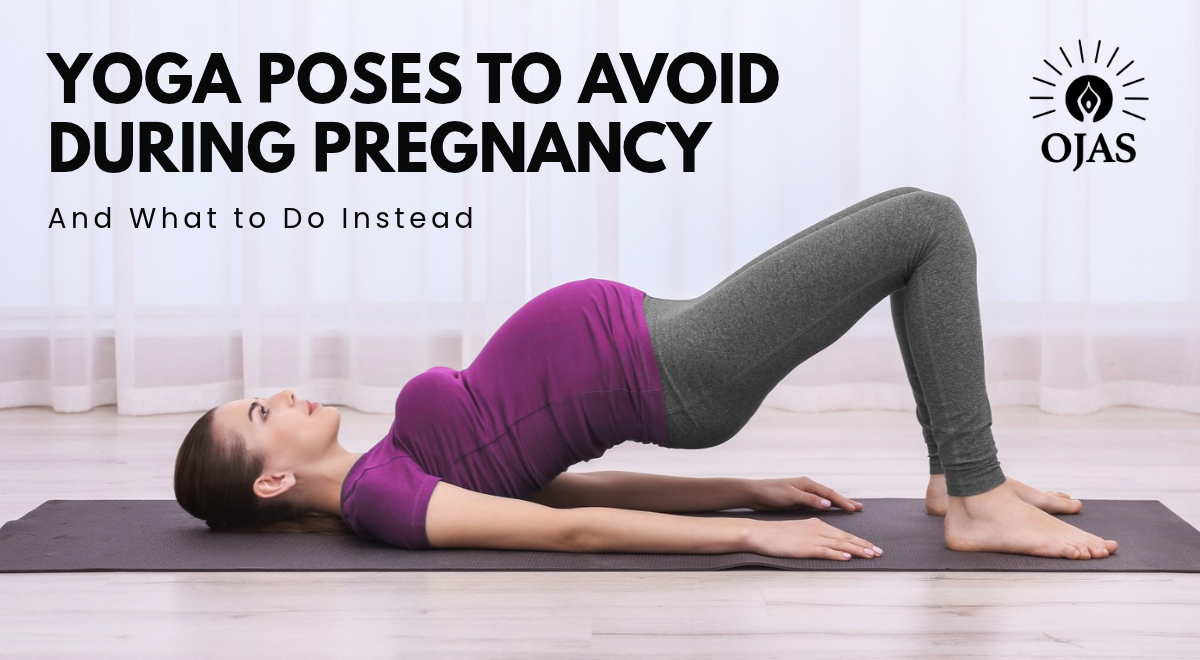
The front of your body is already under strain in pregnancy. Deep backbends add to it and can worsen the separation of the abdominal muscles. Gentle chest openers give the release in the upper back and shoulders without loading the belly. Try standing with your hands clasped behind you or holding a strap, or Camel with your hands on your lower back and only a small lift through the chest. A small Bridge pose can stay in your practice in early pregnancy, but it becomes a lying-on-the-back pose, so treat it like the poses in the previous section from around 20 weeks.
Strong Abdominal Work
Boat pose, crunches, sit-ups and long plank holds put heavy load on the abdominal wall and are best replaced, from the second trimester, by gentler core work that supports rather than strains.
A strong core still matters in pregnancy, but the aim changes from building visible abdominal strength to supporting your back and pelvis. Bird Dog, side-lying leg lifts, and breathing that draws the lower belly in gently on the exhale all train the deep core muscles. Watch for doming, a ridge or cone along the middle of the belly when you exert yourself. It is a sign the abdominal wall is under too much pressure, and the exercise should be made easier or stopped. Short plank holds on the knees can stay in your practice while there is no doming.
Inversions, Arm Balances and Unsupported Balancing
Headstand, Handstand, Crow and balance poses away from a wall all carry a fall risk that grows as your centre of gravity moves forward; beginners should not start them in pregnancy, and experienced practitioners should stop as balance changes.
Falls are the main concern, which is why ACOG advises avoiding activities with a high risk of falling. Experienced practitioners sometimes keep familiar inversions in early pregnancy, but balance can change quickly and unpredictably. If you have not practised a pose before pregnancy, now is not the time to learn it. Shoulderstand and Plow carry a second problem, because they fold the body over the belly. Aerial yoga, popular in Singapore studios, adds both risks: hammock inversions and the fabric pressing across the abdomen, so it is best paused for the whole pregnancy. Downward Dog is a mild inversion that most women can keep in early pregnancy, with hands on blocks or a chair seat if it causes light-headedness or heartburn.
For standing balances, the fix is simple: practise them with a wall or chair within reach. Tree pose with a hand on the wall, Warrior III with hands on a chair, and Half Moon with your back against the wall all keep the strength and focus of balancing without the fall.
Jumping, Forceful Breathing and Hot Yoga
Jump-backs, fast transitions, forceful breathing practices, breath retention and heated classes should all be left out for the whole of pregnancy.
Jumping between poses puts impact through a pelvic floor that is already carrying extra weight, and fast transitions raise the risk of losing balance. Step back instead, and give yourself an extra breath between poses. Forceful breathing practices such as Kapalabhati and Bhastrika pump the abdomen sharply, and holding the breath, especially while bearing down, raises pressure in the abdomen and on the pelvic floor. Slow, continuous breathing, or alternate nostril breathing without the holds, gives you the calming effect without the strain.
Hot yoga is one of the few outright exclusions. ACOG specifically advises against hot yoga and hot Pilates in pregnancy because of the risk of overheating. In Singapore’s heat and humidity, even a non-heated studio can get warm, so drink water, wear light clothing, and ask for a spot near a fan or air-conditioning vent.
Overstretching: A Risk in Every Pose
Relaxin makes deep stretches feel easier than usual, which is exactly why pregnancy is not the time to push into splits, deep hip openers or any stretch at the end of your range.
This is the one item that applies to every pose. A ligament that has been overstretched does not spring back easily, and the pubic symphysis and sacroiliac joints at the front and back of the pelvis are particularly vulnerable. If a hip opener such as Pigeon suddenly feels deeper than ever, treat that as a warning rather than progress. Work at around three quarters of your usual range, keep muscles gently engaged in stretches, and support yourself with blocks so you are not hanging into the joint.
When the Usual Advice Changes: Pelvic Girdle Pain
If you have pain at the front or back of your pelvis, known as pelvic girdle pain or symphysis pubis dysfunction (SPD), the usual prenatal advice to widen your stance reverses: keep your legs closer together and avoid poses that load one leg at a time.
Pelvic girdle pain often feels like a sharp or aching pain over the pubic bone, in the lower back or in the groin. The Royal College of Obstetricians and Gynaecologists lists moving your knees apart, standing on one leg and turning over in bed among the movements that commonly make it worse. In yoga terms, that rules out wide-legged poses such as Goddess, Wide-Legged Forward Fold and deep Butterfly, and single-leg poses such as Warrior III or Tree, for as long as they bring on the pain. Keep stances narrow, move in and out of poses with your knees together, and skip any pose that hurts. A physiotherapist can assess the problem and suggest treatment such as a support belt or specific exercises, so mention it to your doctor or midwife.
The same principle applies to any diagnosis in pregnancy. A low-lying placenta, high blood pressure, or a history of preterm labour may all change what is safe for you, and your doctor’s advice overrides any general list, including this one.
How to Swap a Pose Mid-Class
Tell your instructor you are pregnant before class starts, set up where you can modify without feeling watched, and have three default poses ready for when the class moves on without you.
In a general class, the instructor may not always offer an alternative, so have your own. Child’s Pose with knees wide is your rest. Cat-Cow is your movement when the class goes belly-down or into backbends. A wide-stance Warrior II near the wall is your standing option when everyone else moves into balances or twists. With these three, you can stay in any class without feeling stuck.
A dedicated prenatal class removes the need for this, because every pose is already chosen for pregnancy. Our guide to prenatal yoga by trimester shows how the safe poses change from the first to the third trimester.
Frequently Asked Questions
Which yoga poses should I avoid in the first trimester?
In the first trimester, avoid deep closed twists, strong abdominal work, jumping, forceful breathing with breath retention and hot yoga. Belly-down poses and lying on your back are usually still comfortable early on, but stop if they are not. Fatigue and nausea often set the limits more than any pose. Our guide to yoga in the first trimester covers the early weeks in more detail.
Which yoga poses should I avoid in the third trimester?
In the third trimester, add long holds on your back, forward folds with feet together, unsupported balance poses and all inversions to the list, and slow down every transition. The focus shifts to comfort, breathing and supported positions that prepare you for birth, such as those in our guide to pregnancy yoga poses for an easier delivery.
Is Downward Dog safe during pregnancy?
For most women with an uncomplicated pregnancy, a short Downward Dog is fine in the first and second trimesters. If it causes light-headedness, heartburn or pressure, put your hands on blocks or a chair seat to raise your upper body. Many women replace it with Child’s Pose or a supported version in the third trimester.
Can I do Pigeon pose while pregnant?
Often, yes, with support. Place a block or bolster under the hip of the bent leg so you are not sinking into the joint, and keep your torso upright rather than folding over the belly. If it causes pain in the pubic bone or lower back, replace it with a seated hip opener such as Butterfly.
Is Savasana safe during pregnancy?
In the first trimester, yes. From around 20 weeks, replace lying flat with side-lying Savasana on your left side, or raise your upper body on a bolster. If you feel dizzy or nauseous on your back at any stage, roll onto your side straight away.
I did a closed twist before I knew I was pregnant. Should I worry?
A single twist in early pregnancy is very unlikely to cause harm. The advice to avoid closed twists is about not repeatedly compressing the abdomen as pregnancy continues. If you have concerns, mention it to your doctor at your next appointment.
I practised inversions before pregnancy. Can I keep doing them?
Some experienced practitioners continue familiar inversions in early pregnancy, near a wall and with their doctor’s agreement. Stop as soon as your balance changes or the pose feels different, which often happens in the second trimester. Never learn a new inversion while pregnant.
Can I do regular yoga classes while pregnant?
You can, if you tell your teacher and apply the swaps in this guide, but you become responsible for your own modifications in a class paced for everyone else. A prenatal class is designed for pregnancy from the start, so you do not have to modify on the fly.
Practise Safely With Guided Support
Knowing which poses to avoid is half the picture. The other half is having someone watch your practice and adjust it as your body changes, week by week. A pose that is fine at 14 weeks may need modifying at 24, and the signs are not always obvious from the inside.
In our prenatal yoga classes in Singapore, every pose is already adapted for pregnancy, and your instructor offers the version that suits your stage. You can view current class options at our Joo Chiat, OUE Downtown Gallery and Serangoon Road studios, and bring your questions to your first class.